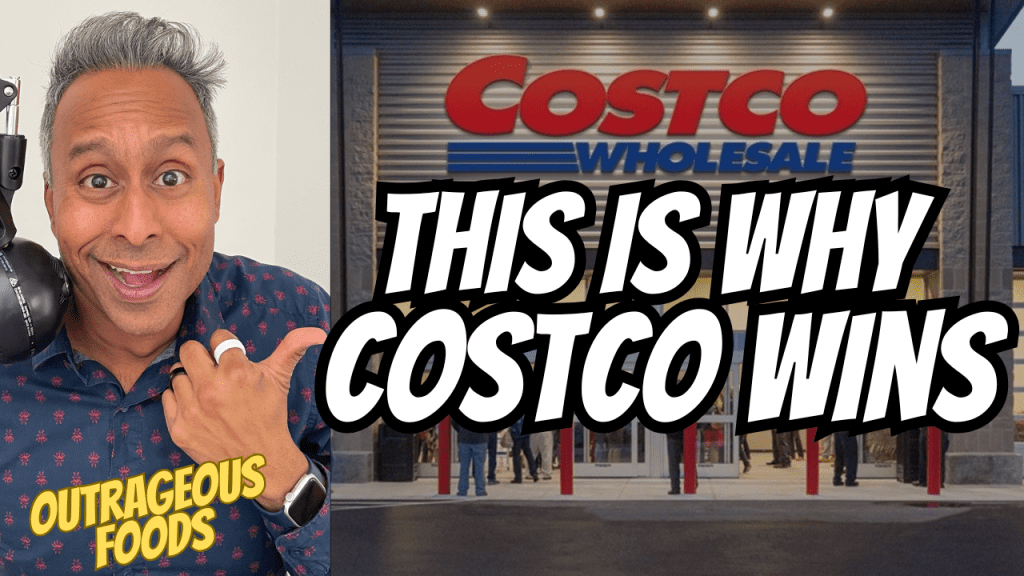
Why the most boring grocery store in America quietly ate everyone’s lunch
Costco didn’t win by being trendy, convenient, or endlessly customizable. It won by refusing to play the modern grocery game at all. Limited selection. Bulk-only. Membership required. And a near-religious obsession with value.
That restraint—paired with ruthless operational discipline—is exactly why Costco didn’t just survive the grocery wars. It ended them.
📺 Outrageous Foods – Episode 12: Costco Won the Grocery Store Wars
👉 Embed YouTube video here

Walk into most grocery stores and you’re hit with choice paralysis:
Costco went the opposite direction.
Instead of 40,000 SKUs like a traditional supermarket, Costco hovers around 3,800–4,000 total items. That’s not a bug. That’s the entire strategy.
Fewer products means:
Costco doesn’t ask what you want. It asks what’s worth selling at scale.

Most grocery stores try to make money on food.
Costco makes its real money before you even walk through the door.
Membership fees generate billions in high-margin revenue every year. That allows Costco to:
Translation: Costco doesn’t need to squeeze you at checkout. It already won when you signed up.

Costco warehouses are loud, crowded, and borderline hostile on weekends.
And yet people love shopping there.
Why?
Costco’s private label (Kirkland Signature) has trained shoppers to believe:
“If Costco sells it, it’s probably good—and priced fairly.”
That trust removes friction. You don’t comparison shop. You just throw it in the cart.
No fake discounts. No digital coupon gymnastics. No psychological warfare.
Big box. Big quantity. Clear value.
If you don’t buy it now, it might be gone next week.
Costco accidentally mastered the drop model before streetwear did.

Online grocery promised speed. Luxury grocers promised vibes. Discount grocers promised chaos prices.
Costco promised one thing:
We won’t rip you off.
That promise—kept consistently for decades—is why Costco customers aren’t just shoppers. They’re evangelists.
And in a moment where grocery inflation, shrinkflation, and price fatigue dominate consumer behavior, that trust matters more than ever.

Costco’s victory isn’t just about groceries.
It’s about where consumer culture is heading:
In an era of excess, restraint is the flex.
And Costco has been flexing quietly for years.

If you liked this breakdown, the full episode dives deeper into:





Leave a Reply