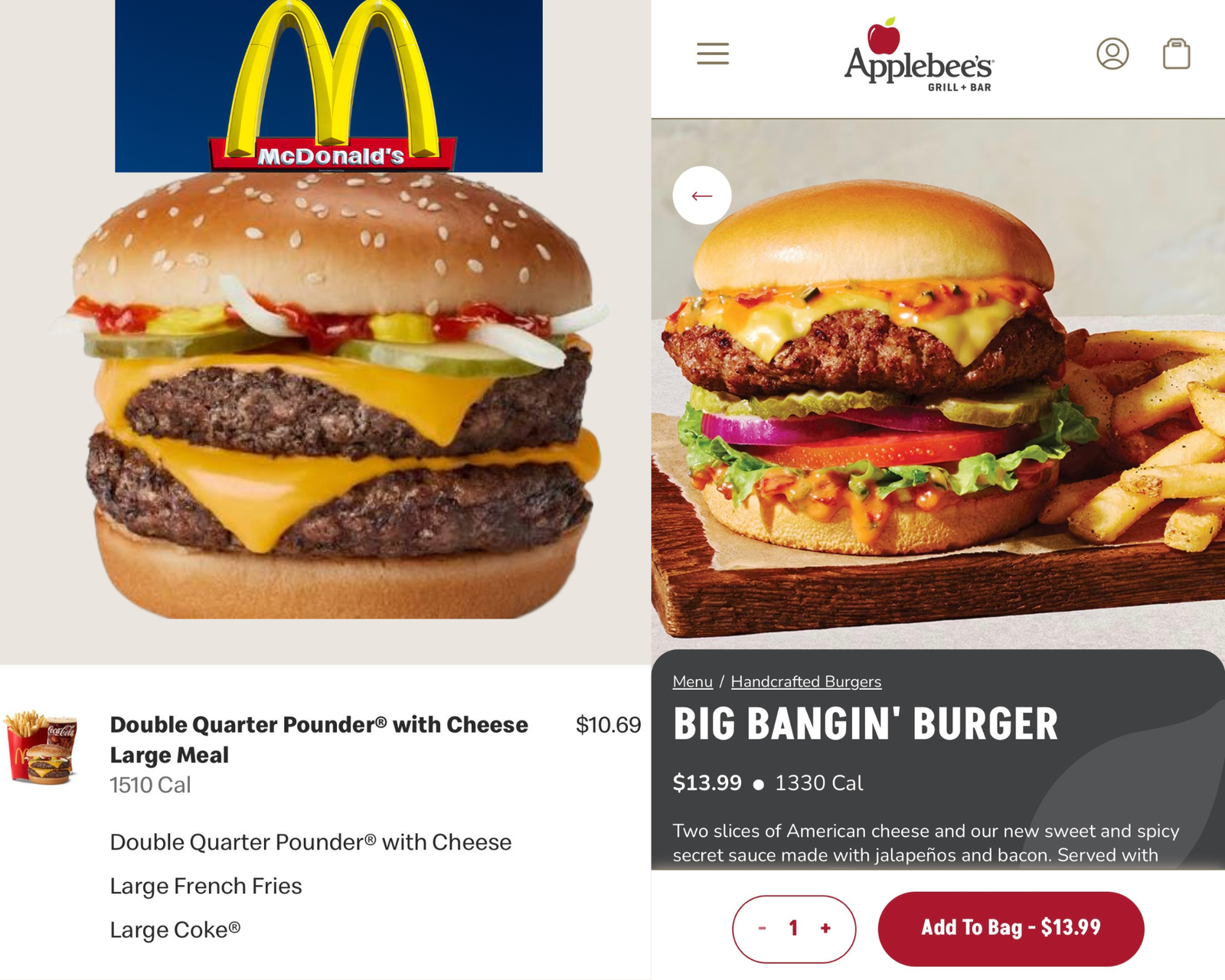
McDonald’s built its global fast food empire on an unmistakable taste and perennial value. But the aftermath of the COVID-19 pandemic has erased its hold on the value conversation. At one point, it was reported that a Big Mac meal was fetching nearly $20 at certain locations.
Prices have settled since then—but they’re still resoundingly higher than they were in 2019.
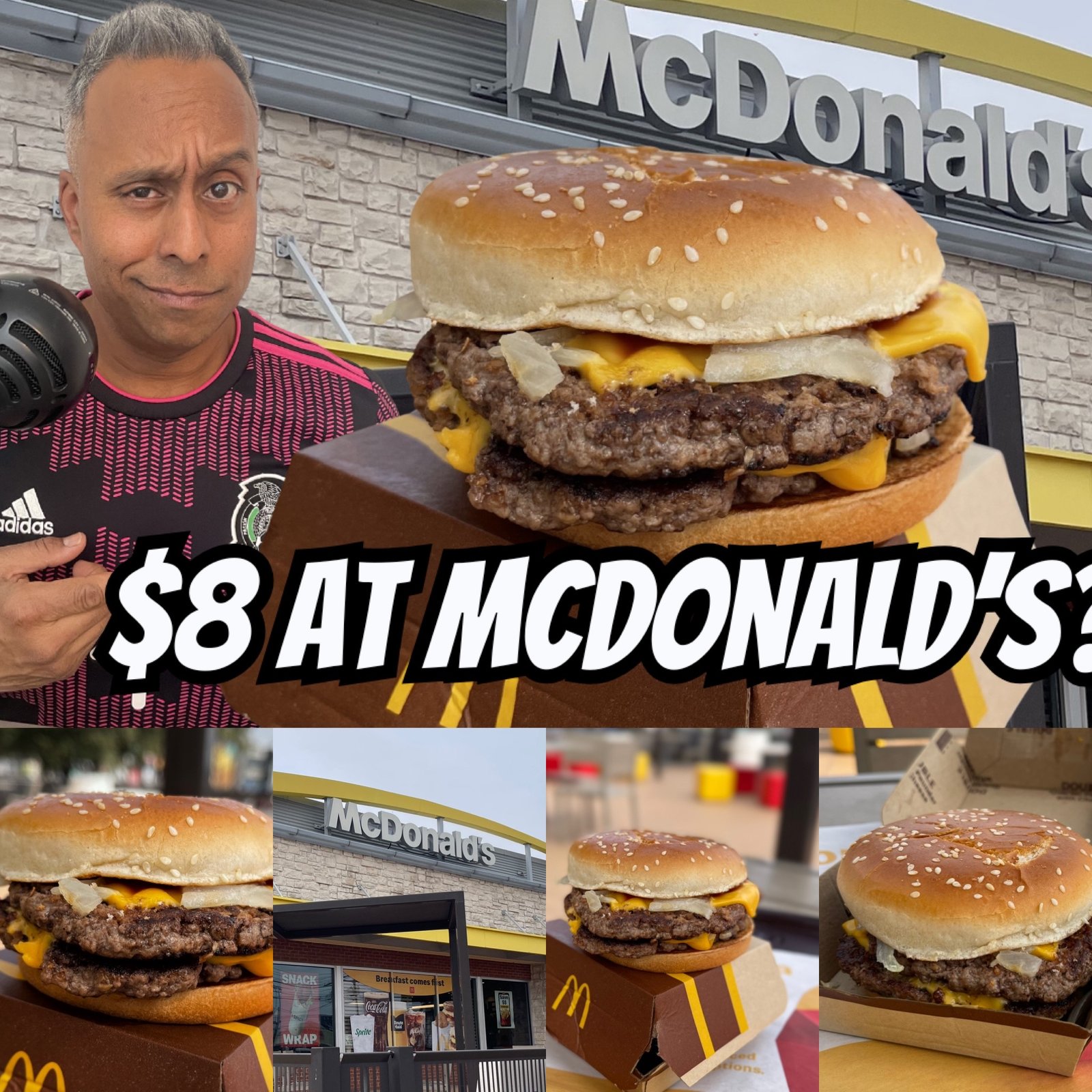
And it also happens to be their best burger by a mile.
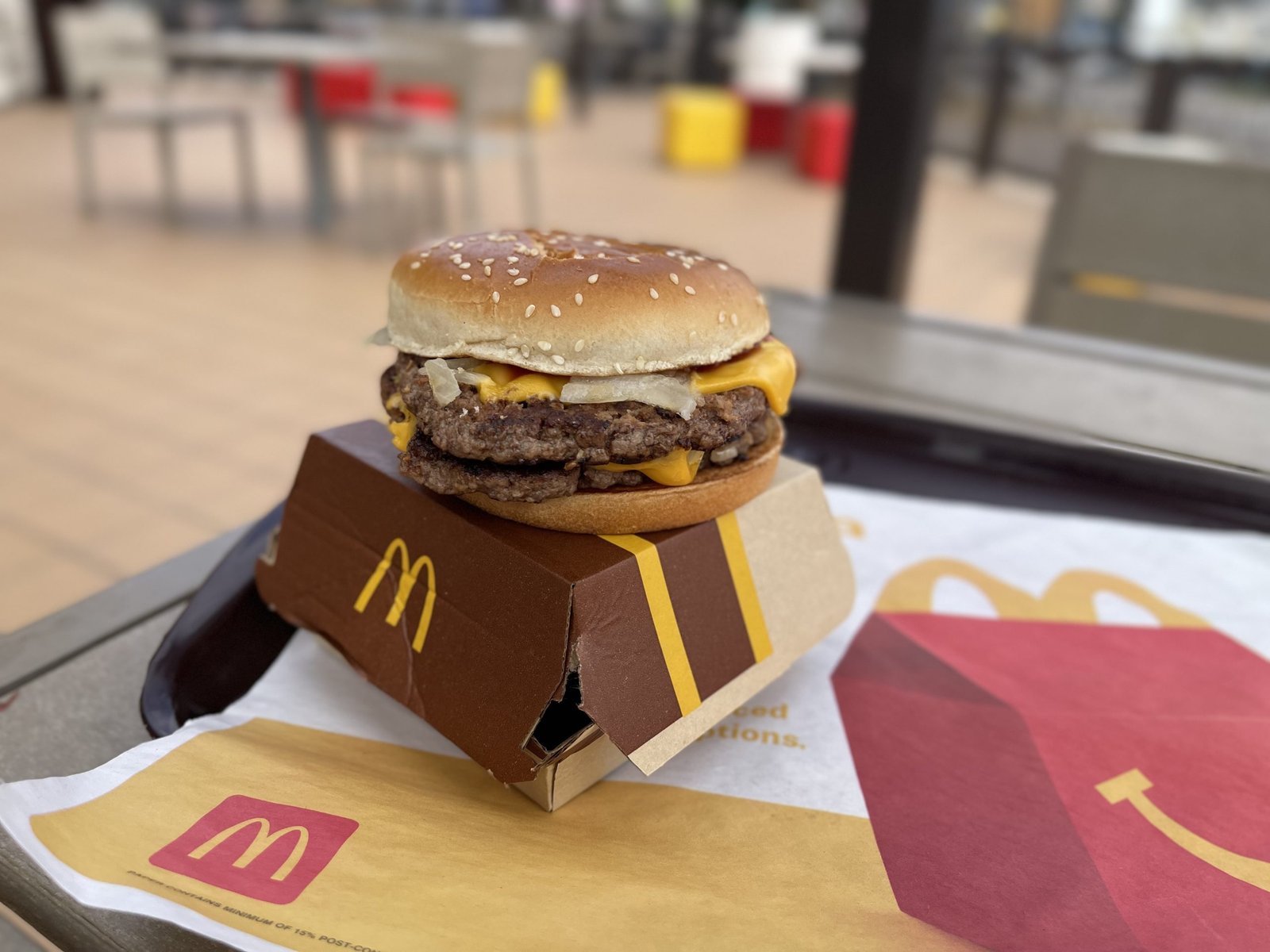
At a location in Austin, Texas, I ordered the Double Quarter Pounder with Cheese. The half-pound double cheeseburger came out to $8.32 with tax, though prices will vary by location.
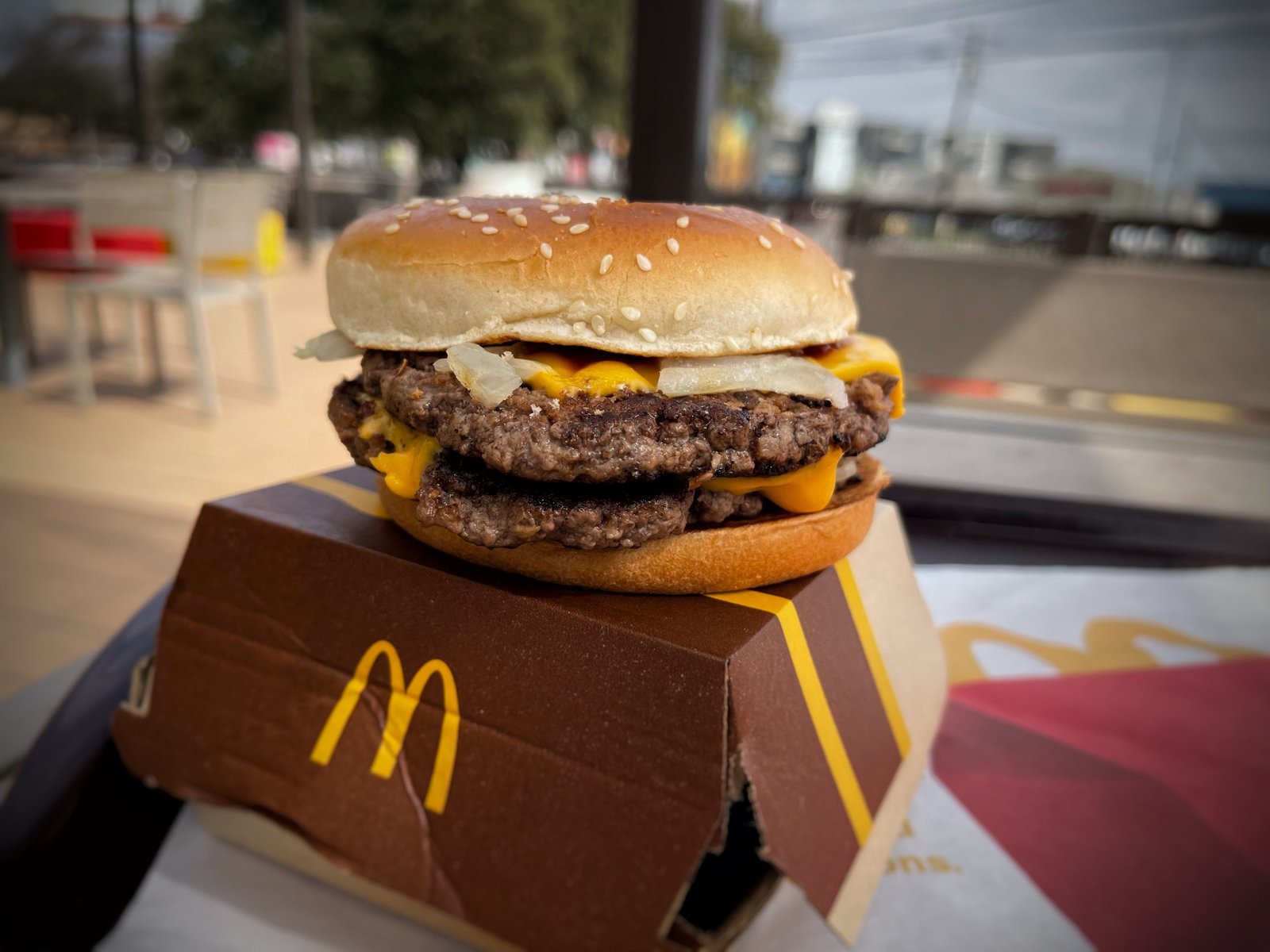
My recent run of expensive fast food burger tests all share one thing in common: they’re cooked to order.
That was true at Five Guys. It was even true at Jack in the Box with their $9 Smashed Jack. At Five Guys, that’s expected. At Jack in the Box, it didn’t help much. At McDonald’s, though, it actually makes a difference—and helps make the case that this burger is almost worth the price.
 The Vitals:
the spot: McDonald's locations worldwide
the eats: Double Quarter Pounder with cheese
the bucks: $8.32 (w/ tax)
the full nelson: the most expensive burger at McDonald's
The Vitals:
the spot: McDonald's locations worldwide
the eats: Double Quarter Pounder with cheese
the bucks: $8.32 (w/ tax)
the full nelson: the most expensive burger at McDonald's
Sadly, no.
It is a good—maybe even great—fast food burger, and it’s easily the best burger on McDonald’s menu. But the price puts it too close to genuinely better burgers from higher-quality chains and local spots.
McDonald’s, in a way, dug its own grave by over-delivering on value for decades. It’s simply too hard to believe that McDonald’s now costs as much as it does.
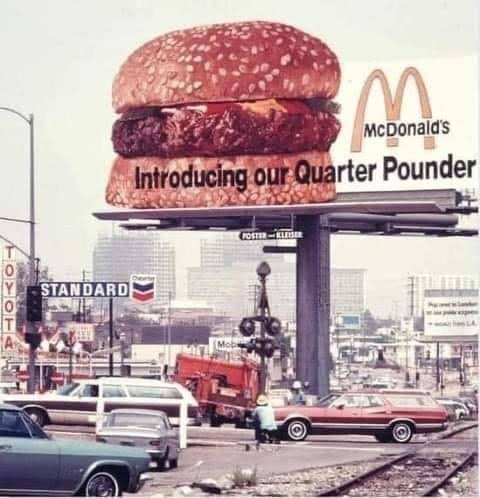
McDonald’s introduced the Quarter Pounder in the 1970s as a competitor to Burger King’s Whopper. The beefier burger held its own as a heavyweight for more than four decades.
Then, in 2015, McDonald’s decided to upgrade quality by switching to fresh, never-frozen beef cooked to order. By 2018, the improved Quarter Pounder hit the market and received fairly positive reviews.
Today, the Quarter Pounder—especially the double—is the best burger at McDonald’s.
This post is part of an ongoing series examining fast food chains through the lens of economics, value, and reality in 2026 and beyond.
If fast food is going to cost more, it has to earn its place.
You can explore more in the series here:
Five Guys Burgers and Fries has long been considered expensive for fast food. In 2026, they sell one of the most expensive burgers in the fast food space. Along with Shake Shack, Five Guys burgers now easily sail past $10 before you even think about fries or a drink.
Fast food prices keep soaring. And that makes the value conversation unavoidable.
Last week, I tried a $9 smash burger from Jack in the Box. If you missed the video, you can catch my full dissatisfaction with the Smashed Jack there. But that was last week.
This week, I’m in the business of even more expensive fast food.
Which brings us to Five Guys.
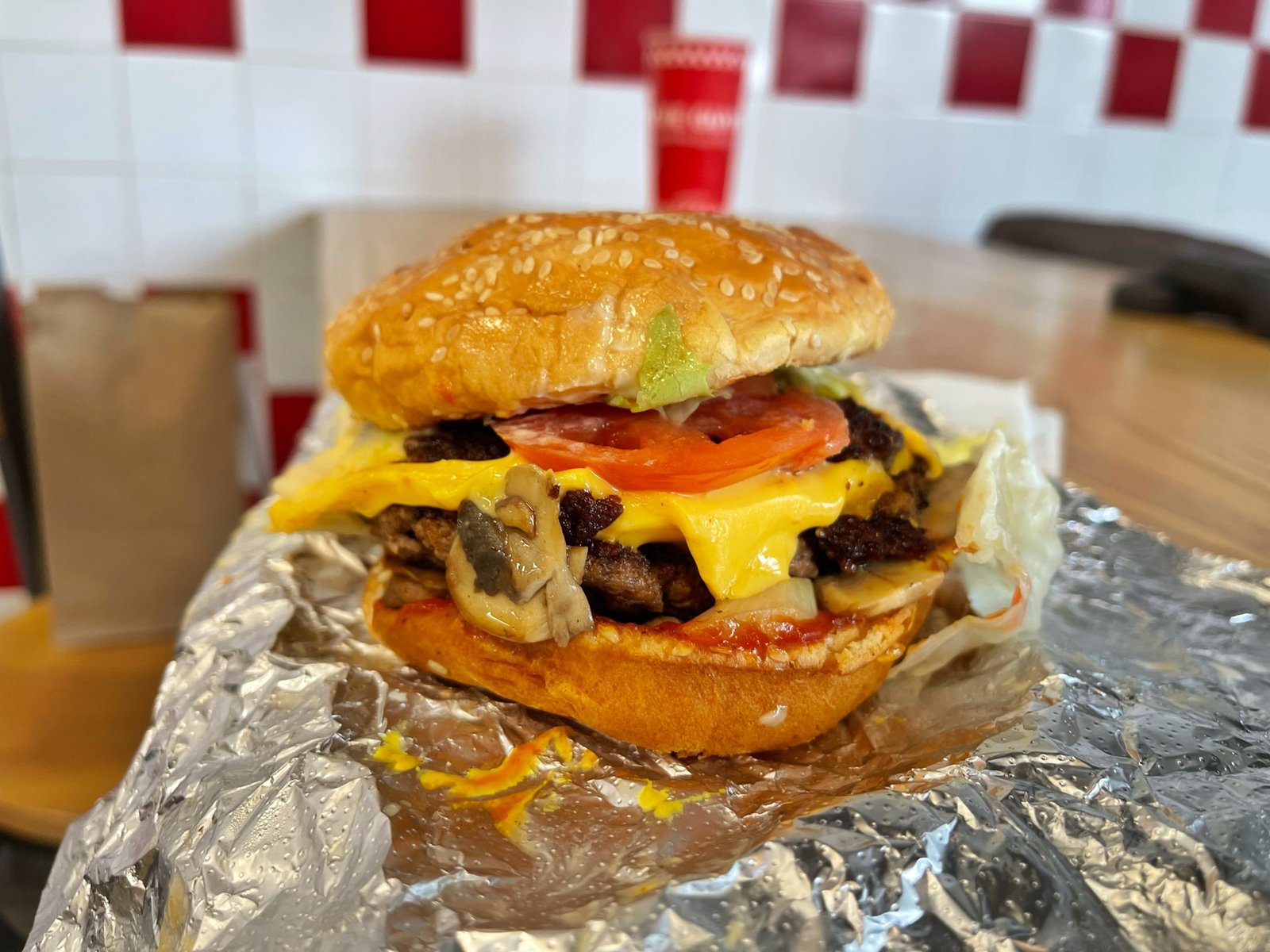
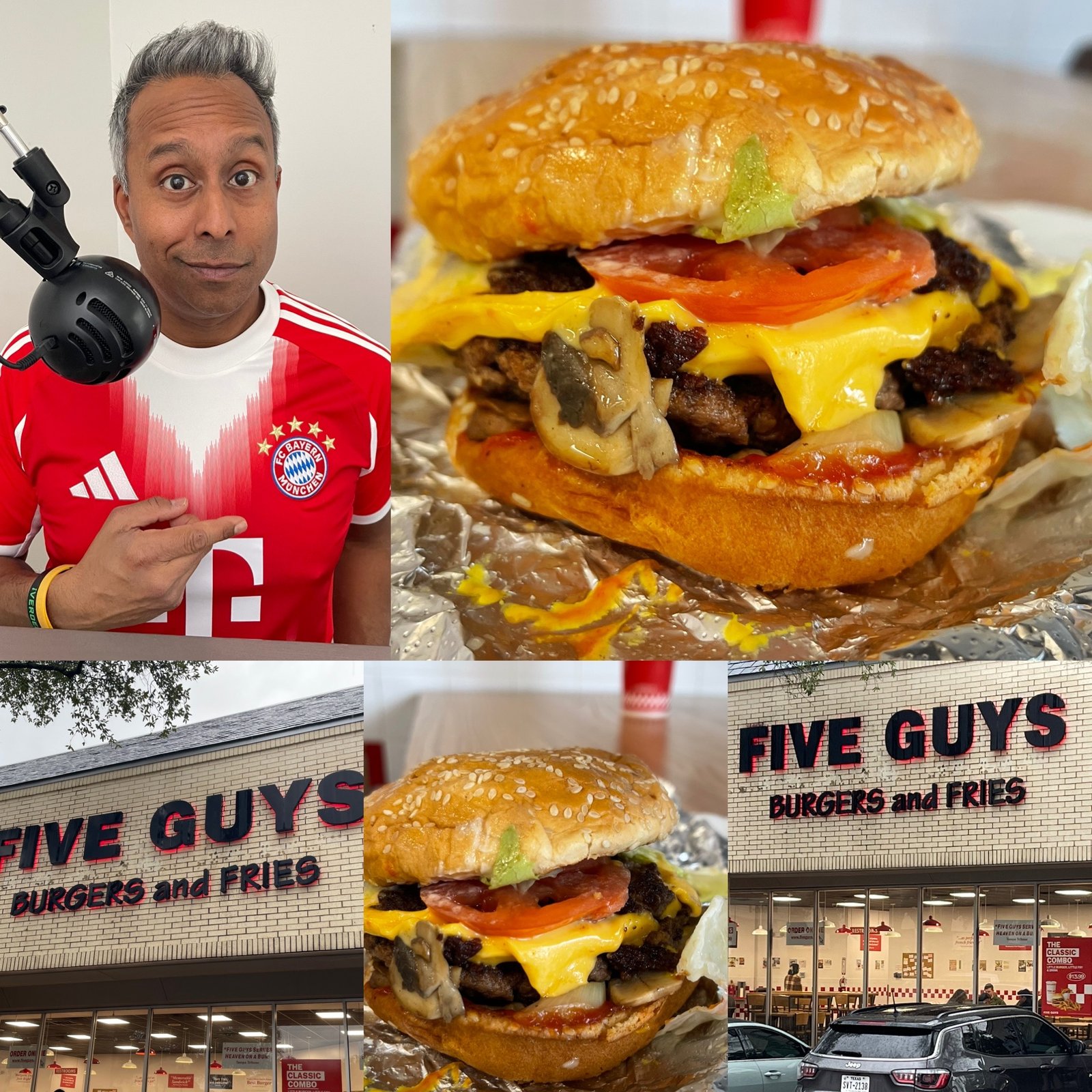
I tried to get my money’s worth. And at Five Guys, that meant getting every topping I could.
To their credit, Five Guys offers extras like grilled mushrooms and grilled peppers at no additional charge. At most places, those kinds of add-ons cost extra. Here, they’re included.
That’s a real point in their favor.
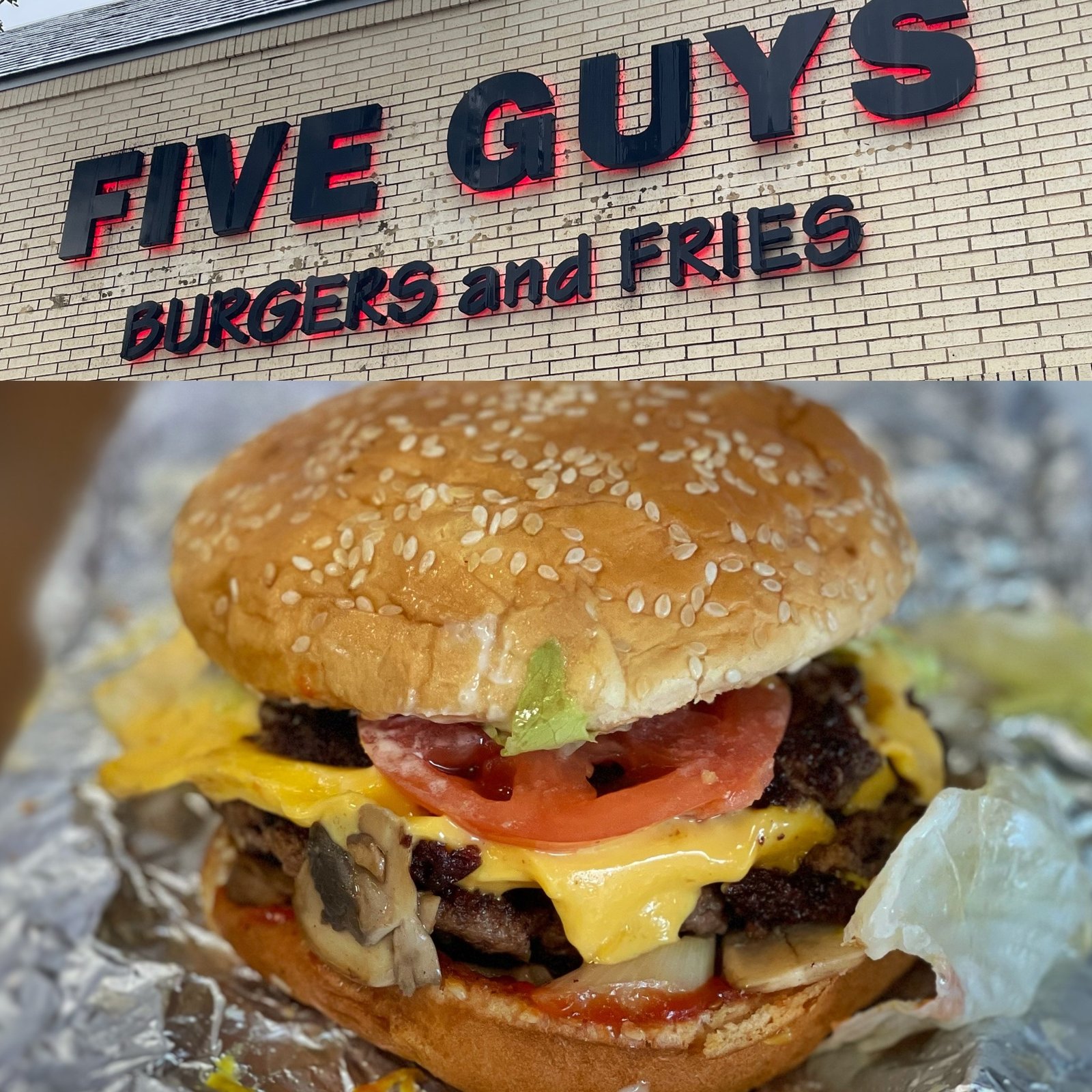 The Vitals:
the spot: Five Guys locations nationwide
the eats: Cheeseburger
the bucks: $12
the full nelson: the most expensive burger in fast food
The Vitals:
the spot: Five Guys locations nationwide
the eats: Cheeseburger
the bucks: $12
the full nelson: the most expensive burger in fast food
I’ve had Five Guys a handful of times over the years, and it never really moved me. The first time I had it, I found it expensive. And it’s always irked me that they cook their burgers well done but still call them “juicy.”
For what it’s worth, I think the fries are the best thing on the menu.
With all that said, I was pleasantly surprised this time.
The burger is massive. Despite the price tag, you are getting a substantial amount of food. It may come in a brown paper bag, but you’re getting one hearty meal, even without the fries.
In short: it was almost worth it.
I get into this more in the video, but I do think Five Guys comes close to making a real case for value compared to other fast food restaurants.
The problem is context.
For working families, Five Guys starts to feel like a luxury fast food option—one that doesn’t always add up. I wouldn’t be mad about eating a Five Guys burger again. But I also don’t think it would be my first choice, especially if I could find a better burger restaurant for just a little more money.
This post is part of an ongoing series examining fast food chains through the lens of economics, value, and reality in 2026 and beyond.
If fast food is going to cost more, it has to earn its place.
You can explore more in the series here:
Last week I published a review of Popeye's iconic fried chicken sandwich to see if it was still worth it in 2026.
The answer turned out to be surprisingly easy: not only was it still reasonably priced, it also shocked me with how good it was.
That was last week.
This week, it’s Jack in the Box — and their nearly $9 smash burger called the Smashed Jack.
I had high hopes.
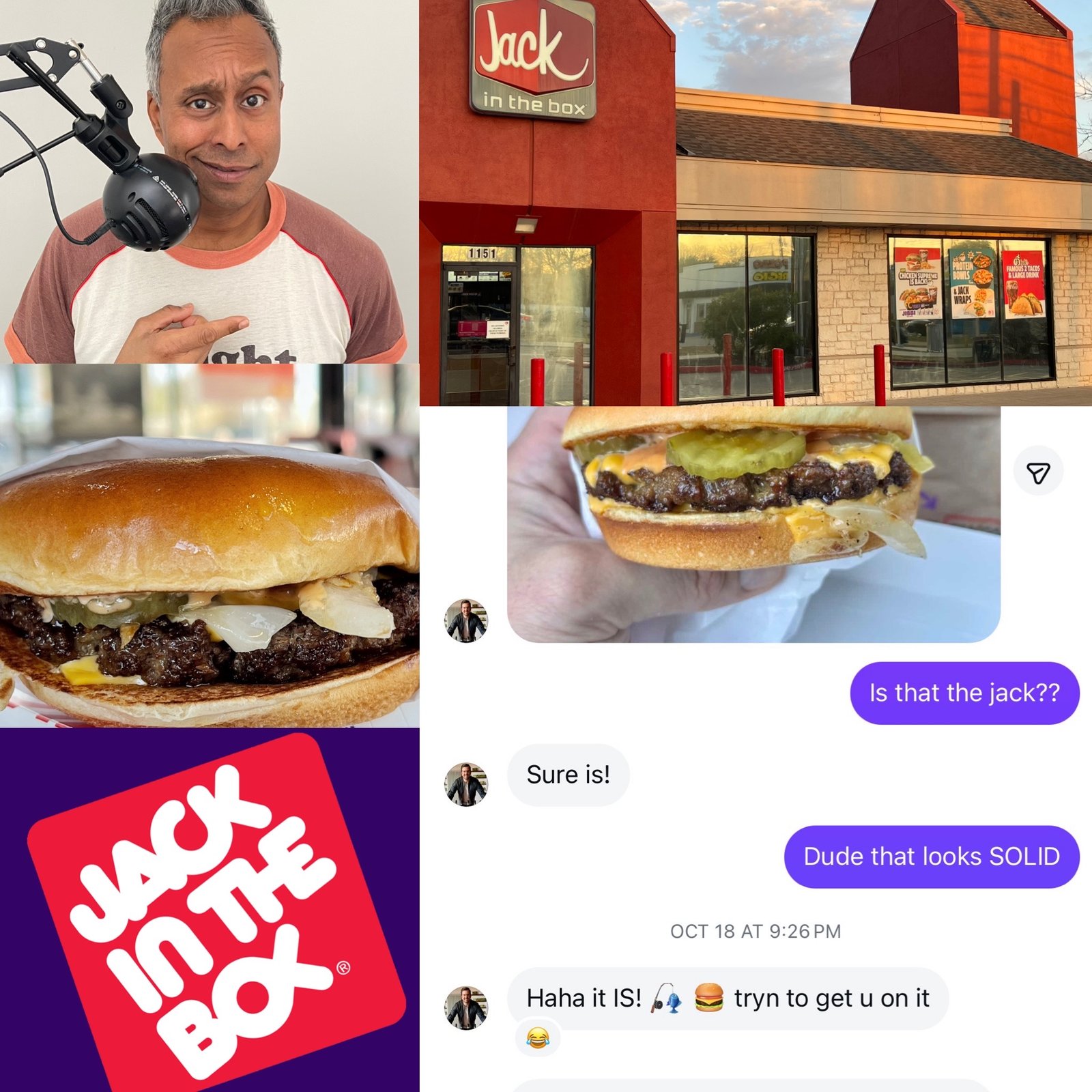
I was skeptical. But I also got a strong endorsement: a DM on Instagram encouraging me to try the Smashed Jack.
And this wasn’t from a random follower. The person (who will remain unnamed) is associated with one of the more famous hamburger restaurants in America.
I was also warned it would be pricey. That part wasn’t surprising — and, oddly, it was a little encouraging. When something costs more, you expect more.
Especially from a chain that was recently named the worst fast food burger chain by Tasting Table. I can’t argue much there. I hadn’t eaten at Jack in the Box in about 15 years.
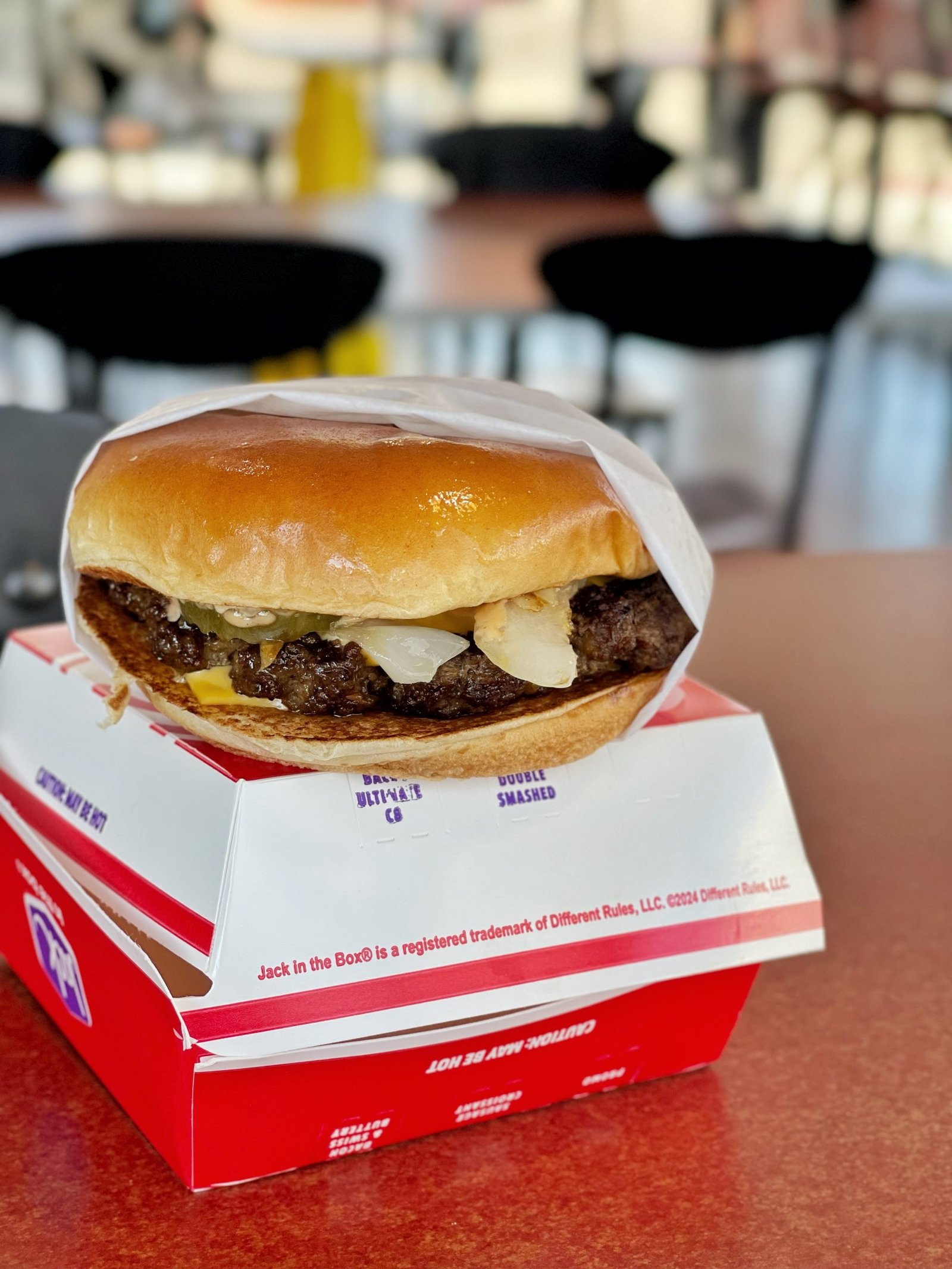 The Vitals:
the spot: Jack in the Box locations nationwide
the eats: Smashed Jack
the bucks: $8.89
the full nelson: can Jack in the Box deliver a smash burger worth $9
The Vitals:
the spot: Jack in the Box locations nationwide
the eats: Smashed Jack
the bucks: $8.89
the full nelson: can Jack in the Box deliver a smash burger worth $9
At $9, Jack in the Box is putting itself in Shake Shack and Five Guys territory.
And in the case of Shake Shack, that kind of pricing comes with expectations: better ingredients, better execution, better flavor. Or at least, that’s how it should work.
To be fair, the burger is a looker.
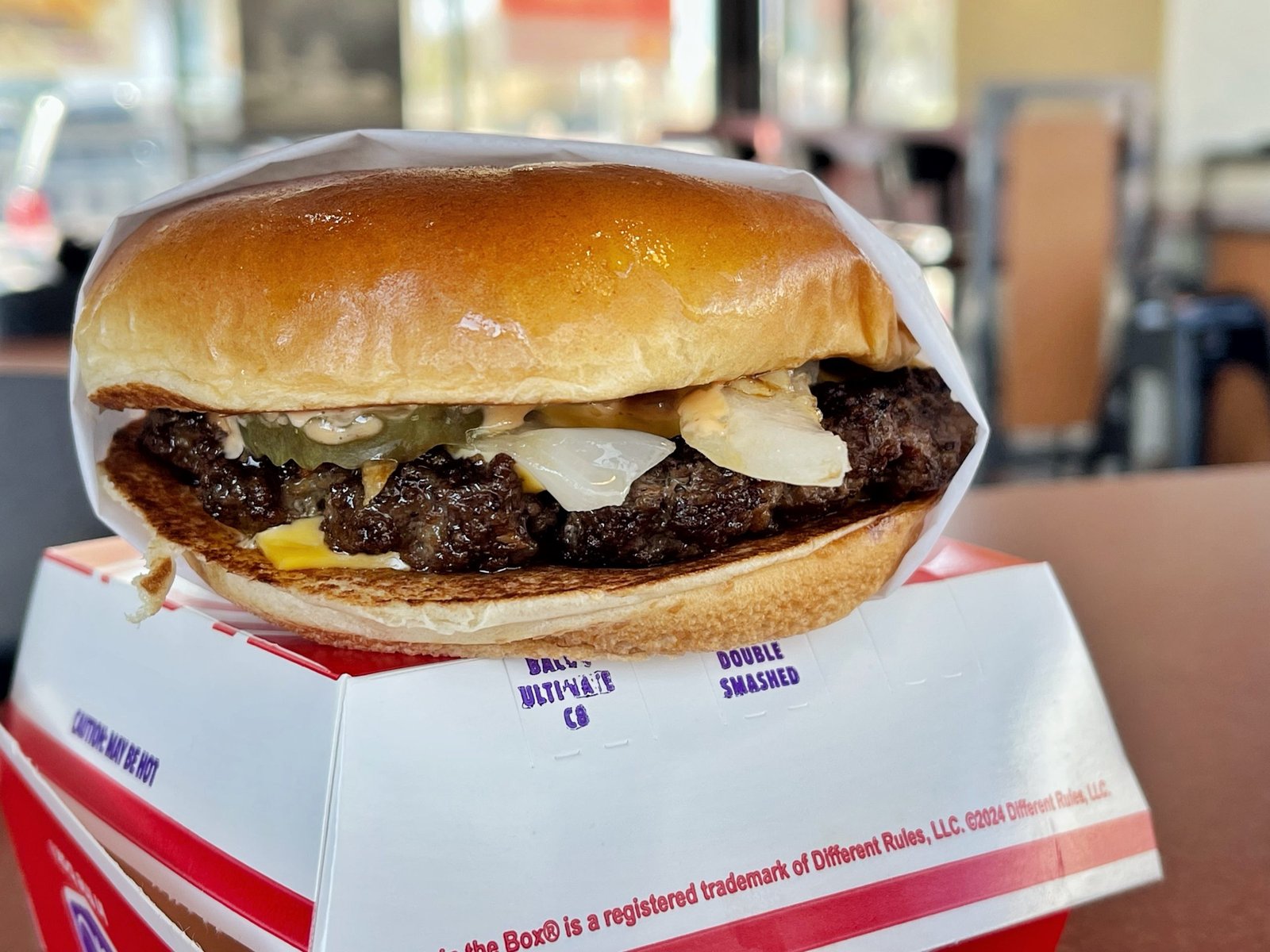
Both in the DM and in real life, the Smashed Jack looks good. The simplicity works: meat, cheese, bun, and a minimal set of toppings — lightly grilled onions, pickles, and a tangy sauce. Even the meat-to-bun ratio feels right.
On paper, this all makes sense.
And then you taste it.
The patty is the downfall. It tastes heavily processed, with enough sodium to moonlight as breakfast sausage. The beef flavor is muted, replaced by a distinctly processed, overly seasoned profile.
The pickles are limp and bring no punch. The sauce is mayo-heavy and forgettable. What should be a simple, craveable smash burger ends up feeling engineered rather than cooked.
This is the kind of burger that looks right and eats wrong.
Hell naw.
It’s not even worth eating.
The Smashed Jack is both bad and expensive, which is the worst possible combination. Shake Shack is leagues better. And honestly? I’d take a McDonald’s Quarter Pounder with Cheese over this without hesitation.
At $9, this burger doesn’t just miss the mark — it fails the entire value conversation.
This post is part of an ongoing series examining fast food chains through the lens of economics, value, and reality in 2026 and beyond.
If fast food is going to cost more, it needs to earn its place.
You can explore more in the series here:
The 2026 Super Bowl is upon us, and even if you don’t have a team to root for, it’s always a great excuse to have people over, crack a few beers, and eat very well. While there are plenty of Super Bowl recipes out there, they all involve that pesky concept of cooking. Sometimes it’s easier to outsource that part so you can concentrate on the crucial third-and-long moments — and, of course, the commercials.
If you’re looking for where to order Super Bowl food in Austin, these are my picks for the best Austin restaurants for Super Bowl takeout and catering this year.
PS — GO SEAHAWKS. There, I said it.
 The Vitals:
the spot: La Plancha 701 E Martin Luther King Jr Blvd Unit 101, Austin, TX 78702
the eats: tortas and tacos including buffet packages
the bucks: $15 per torta, $25 a person for catering packages
the full nelson: The best tortas in town for the biggest game of the year
The Vitals:
the spot: La Plancha 701 E Martin Luther King Jr Blvd Unit 101, Austin, TX 78702
the eats: tortas and tacos including buffet packages
the bucks: $15 per torta, $25 a person for catering packages
the full nelson: The best tortas in town for the biggest game of the year
La Plancha is a torta specialist from a chef whose accolades include a degree from the Culinary Institute of America. That’s reason enough to eat there — but here’s a better reason to order La Plancha for Super Bowl Sunday: tortas travel.
Unlike tacos, which tend to get soggy, tortas — the iconic Mexican sandwich — can handle some time in transit. Heck, they can sit around through a quarter of football… with timeouts.
If you really want to do it up, consider the catering package and set up a build-your-own torta bar at home. Whatever you do, place your order early. These bespoke Mexican sandwiches tend to sell out, especially around big game weekends.
 The Vitals:
the spot: Loro 2115 S Lamar Blvd, Austin, TX 78704
the eats: Loro Super Bowl Bundle: wings, ribs, BBQ pork sliders, Sesame Noodles, Corn Fritters, Chips n Queso 'n kimchee, dozen cookies
the bucks: $190 and feeds 4-6 ppl
the full nelson: MVP of Super Bowl food to go
The king of Brisket and the king of sushi make a compelling case to NOT light up the BBQ this year. Aaron Franklin and Tyson Cole teaming up
The Vitals:
the spot: Loro 2115 S Lamar Blvd, Austin, TX 78704
the eats: Loro Super Bowl Bundle: wings, ribs, BBQ pork sliders, Sesame Noodles, Corn Fritters, Chips n Queso 'n kimchee, dozen cookies
the bucks: $190 and feeds 4-6 ppl
the full nelson: MVP of Super Bowl food to go
The king of Brisket and the king of sushi make a compelling case to NOT light up the BBQ this year. Aaron Franklin and Tyson Cole teaming up
The king of brisket and the king of sushi make a very compelling case to not light up the BBQ this year. Aaron Franklin and Tyson Cole teaming up for your Super Bowl catering in Austin is like finding out Superman is your Uber driver — and he’s picking you up in the Batmobile.
This might be the ultimate Austin food flex for Super Bowl Sunday: smoked meats, wings, and sides that actually travel well and feed a crowd without stress. If you’re hosting and want one easy, premium order that covers all the bases, this is it.
 The Vitals:
the spot: Roots Chicken Shak 1801 E 51st St, Austin, TX 78723 (@HEB Mueller)
the eats: Duck fat fried Chicken Strips, wings and sandwiches
the bucks: $$
the full nelson: You have to go to HEB anyways
The Vitals:
the spot: Roots Chicken Shak 1801 E 51st St, Austin, TX 78723 (@HEB Mueller)
the eats: Duck fat fried Chicken Strips, wings and sandwiches
the bucks: $$
the full nelson: You have to go to HEB anyways
I don’t know what’s more surprising: that a celeb chef like Tiffany Derry has an outpost of her fried chicken concept inside a grocery store (shoutout, H-E-B), or that it doesn’t cost much more than hitting up Raising Cane’s.
Either way, these duck fat fried chicken tenders will absolutely upgrade your Super Bowl takeout in Austin. Don’t skip the Caesar salad, either. You’ll thank me later.
 The Vitals:
the spot: Feral Pizza 500 E 51st St, Austin, TX 78751
the eats: NY-New Haven pizza hybrid
the bucks: $$
the full nelson: My new pizza crush
The Vitals:
the spot: Feral Pizza 500 E 51st St, Austin, TX 78751
the eats: NY-New Haven pizza hybrid
the bucks: $$
the full nelson: My new pizza crush
I’m head over heels in love with the tomato pie at Feral Pizza. It skips the mozzarella in favor of a well-baked layer of tomato sauce with a fine dusting of Pecorino. The simple umami of the tomato lets the dough — fermented for 72 hours — really show off its sourdough character.
That said, since this is Super Bowl food, the Supreme with its meat-heavy point of view might be what the buzzed bros are expecting. This is not the time for nuance. It’s the Super Bowl. And someone from the Salesforce sales team will almost certainly need something to soak up the Jell-O shots they had for breakfast.
Whatever you choose for your Super Bowl food in Austin, pick up the phone and place your order sooner rather than later. The best Austin restaurants always book up fast for the big game.
The last thing you want to do is stand by your grill turning hot dogs when you could be on the couch, watching football, and feasting on some of the best Super Bowl takeout and catering Austin has to offer.
Last year, I published a review of Raising Cane’s tied to a then-surprising realization: fast food was getting expensive.
That reality hasn’t faded. If anything, it’s accelerated.
Along with groceries, the cost of dining out has soared, and it’s actively reshaping how — and how often — we eat. Value matters again. And not in the abstract. In real dollars.
Which brings us to Popeyes.
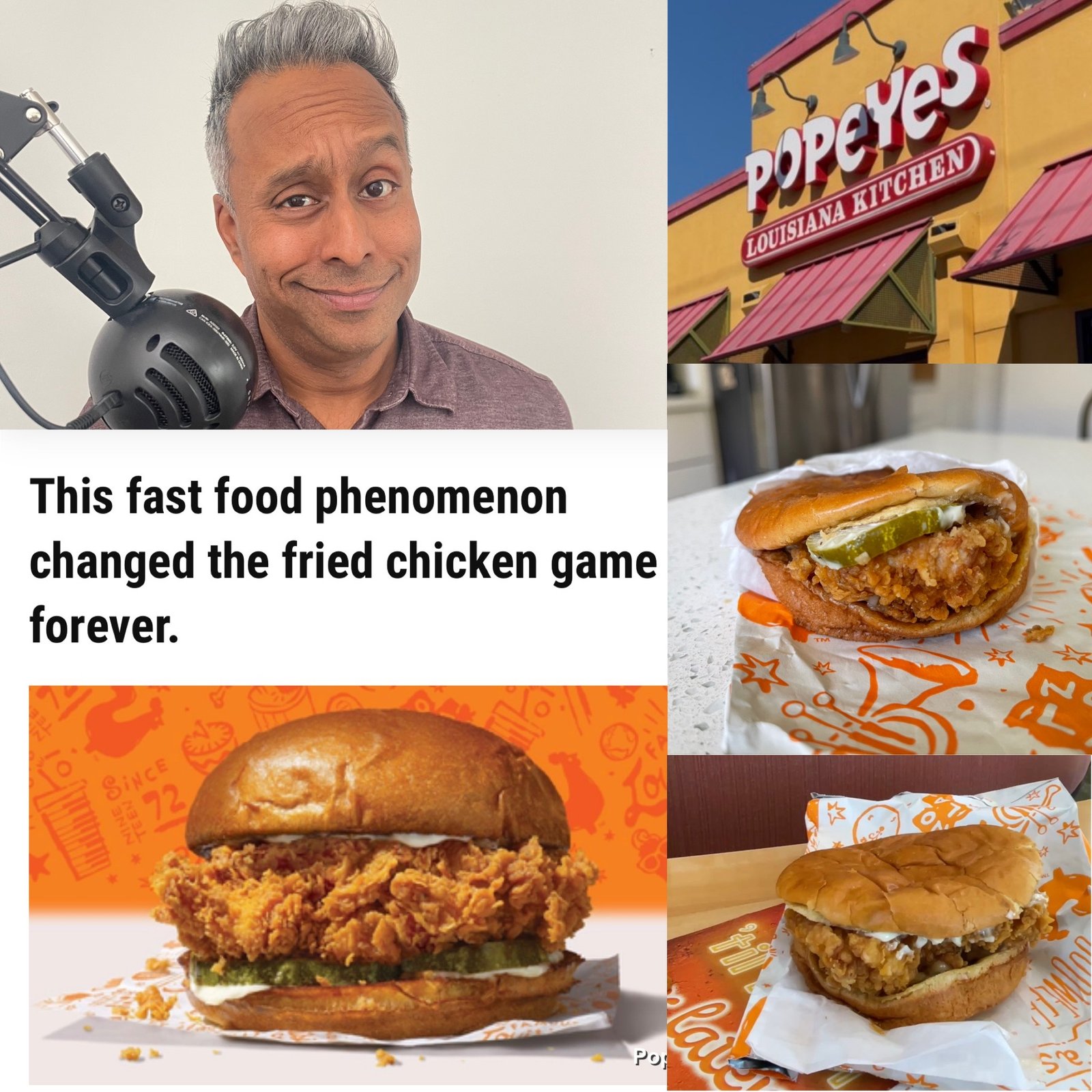
Popeyes single-handedly ignited the fried chicken sandwich wars in 2019 with the launch of its now-iconic fried chicken sandwich. It wasn’t just a hit — it was a cultural moment.
Food writers, food obsessives, and Reddit threads all converged on the same conclusion: this sandwich was great.
But in 2026, with fast food prices climbing across the board, the real question isn’t whether it’s good.
It’s whether it’s still worth it.
That’s what I set out to find.
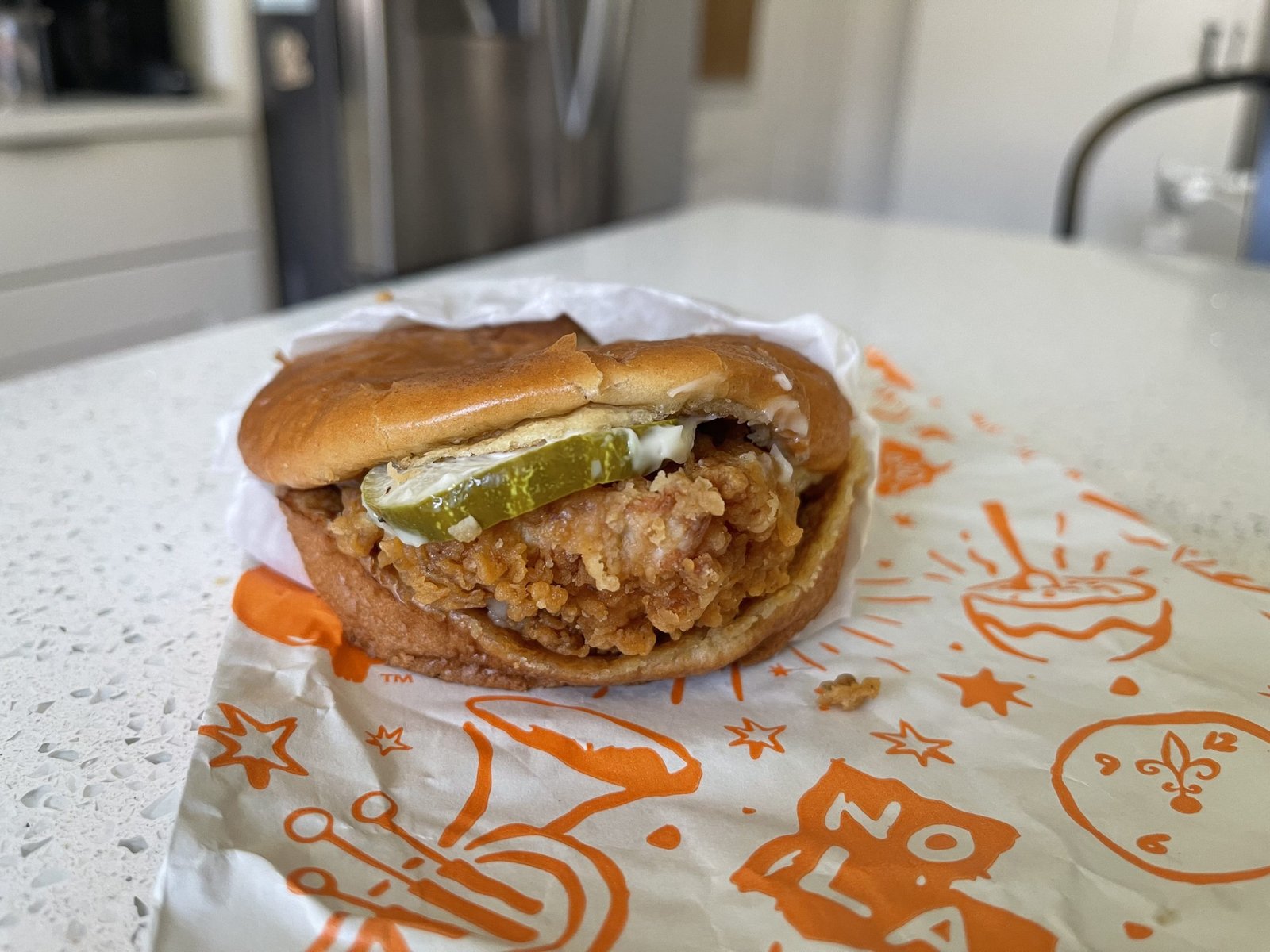
The Vitals: the spot: Popeyes locations nationwide the eats: Classic Fried Chicken Sandwich the bucks: $5.49 the full nelson: is the iconic fast food fried chicken sandwich still worth it?
When Popeyes introduced the fried chicken sandwich in 2019, it cost $3.99.
Today, that same sandwich costs $5.49 — a 37% increase.
On paper, that sounds steep. In reality, a $6 sandwich that’s filling and well-executed is now the baseline in 2026. Whether at small chains, fast-casual spots, or food trucks, this is the new normal.
So the real test isn’t sticker shock — it’s value delivered.
Let’s start with the ugly.
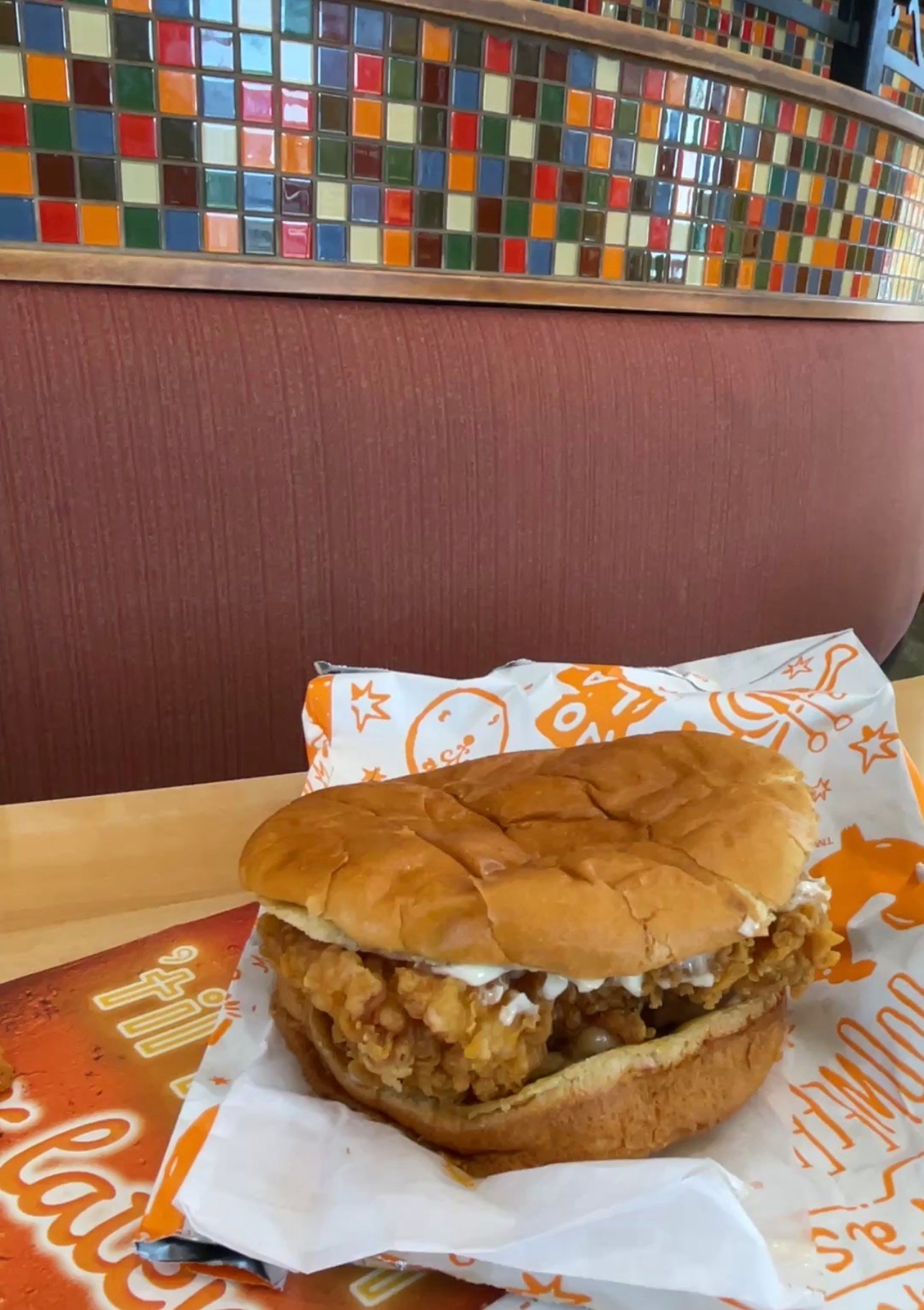
The Popeyes fried chicken sandwich is not served delicately. It arrives tucked into a folded wrapper, slightly smashed, with a brioche bun that often looks like it lost a fight with a panini press or a George Foreman Grill (remember those?). The pickles were limp. The mayo felt forgettable.
And none of that mattered.
The chicken was juicy, aggressively seasoned, and substantial. A real piece of fried chicken — not a skimpy cut hiding behind breading.
As someone who rarely eats fast food and has had plenty of highly regarded fried chicken sandwiches (Hattie B’s included), I was genuinely impressed.
And yes — this was my first time ever eating the Popeyes fried chicken sandwich.
Unequivocally, yes.
When compared to small chains and food trucks charging double — sometimes more — the Popeyes fried chicken sandwich delivers real value. The portion is competitive. The flavor holds up. And the experience is fast.
This is one of the rare moments where fast food still delivers on the promise that made it an American staple for decades: flavor, value, and efficiency.
I’d be remiss if I didn’t share the one factor that made this experience genuinely positive:
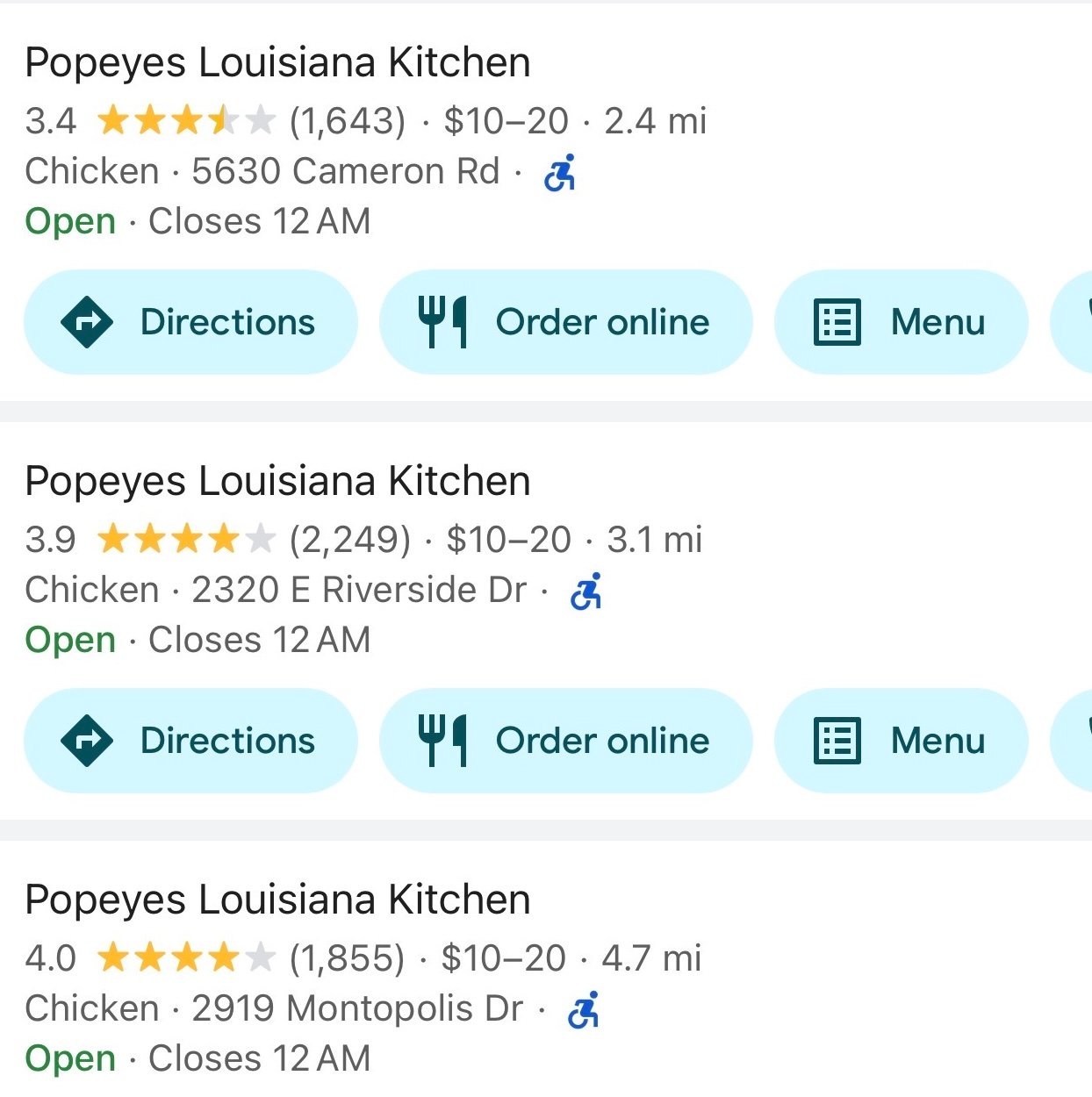
Choose your Popeyes location wisely.
Fast food loves to sell consistency as part of its DNA. Reality tells a different story.
My solution is simple: use Google Maps.
I drove to a Popeyes with higher reviews instead of the closest one — and it made a difference. After filming the video review, an employee asked what I thought and mentioned she had worked at that location for six years. She talked about regular customers.
That kind of pride and care is something we usually associate with mom-and-pop restaurants — not national fast food chains.
But it was happening here. And it mattered.
This post is part of an ongoing series examining fast food chains through the lens of economics, value, and reality in 2026 and beyond.
If fast food is going to cost more, it needs to earn its place.
You can explore more in the series here:
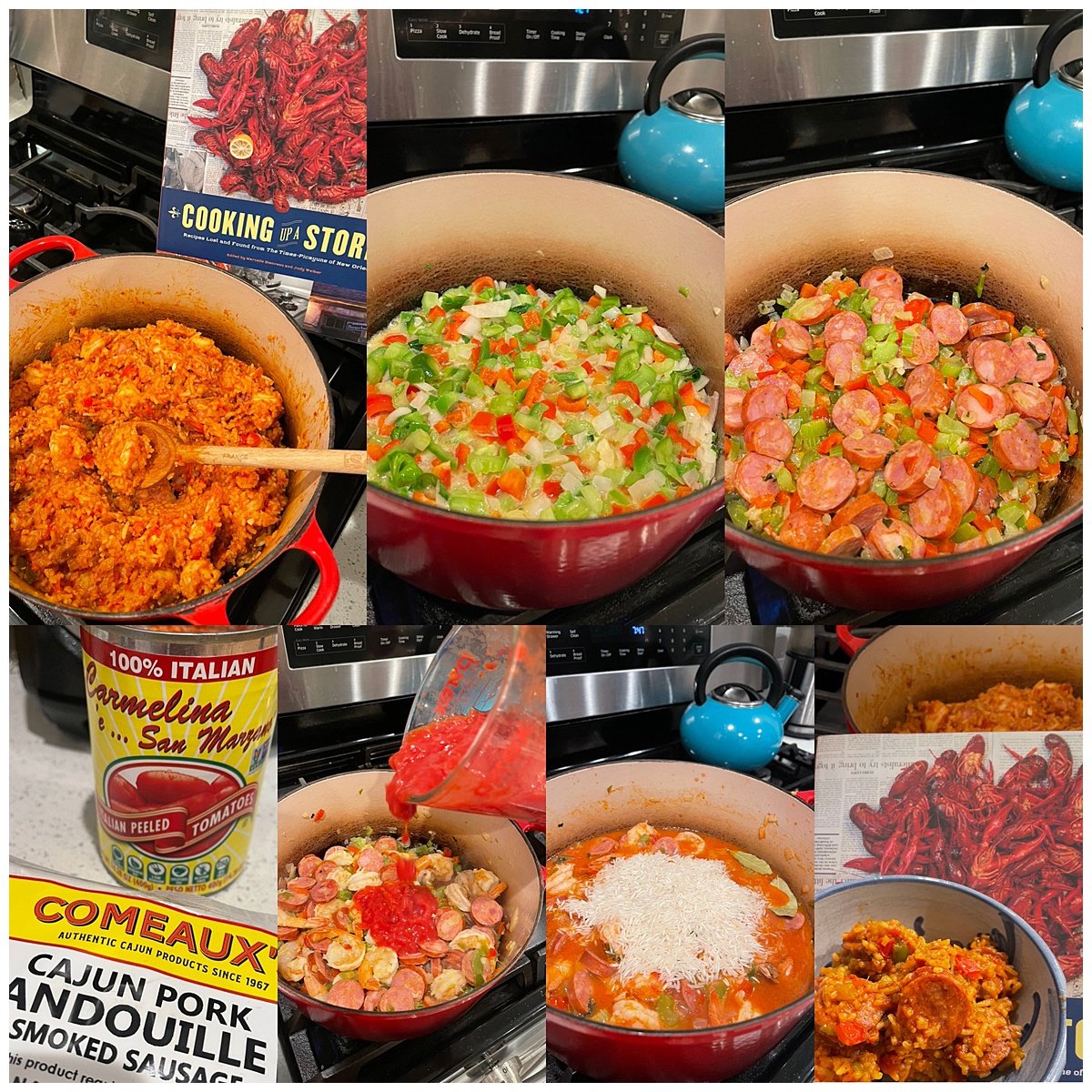
This is the best jambalaya I’ve ever had — and I make it at home.
This New Orleans–style red jambalaya leans on good andouille sausage, quality canned tomatoes, shrimp, and a long-grain rice that holds its texture. It’s rich, comforting, and even better the next day.
Below is how to make jambalaya my way, plus a few key tips that make a real difference.
(Serves 4–6)
6 tablespoons butter
½ cup chopped green onion (white and green parts)
½ cup chopped yellow onion
1 large bell pepper, chopped
1 cup chopped celery
1 garlic clove, minced
I use about 1 tablespoon; the original recipe calls for 1 teaspoon, which is nothing in my book
1 pound shrimp, shelled and deveined
1 pound andouille sausage
Use a good brand like Comeaux if you can
1 (16-ounce) can crushed tomatoes
Buy the good stuff here — it’s an easy upgrade
1 cup chicken broth (homemade preferred)
Salt, to taste
Cayenne pepper, to taste (don’t be weak in the knees)
2 bay leaves
1 cup long-grain rice (I use basmati)
Hot sauce, for serving (I’m a Tabasco man)
Melt the butter
Melt the butter in a heavy-bottomed pot (an enameled Dutch oven is ideal) over medium heat.
Cook the vegetables
Add the yellow onion, green onion, celery, bell pepper, and garlic. Cook until the onions are translucent, stirring often.
Tip: Add the garlic later if you’re worried about burning it.
Brown the andouille sausage
Add the andouille sausage and cook until it turns from pale pink to deep red with light browning. This step builds flavor.
Add the shrimp
Add the shrimp and cook just until they start to curl and turn pink. Shrimp cook fast — don’t overdo it.
Add tomatoes and broth
Stir in the crushed tomatoes and chicken broth. Season with salt, cayenne, and bay leaves.
Add rice and simmer
Stir in the rice, cover, and reduce heat to a low simmer. Cook until the liquid is absorbed, about 25 minutes.
Check at 20 minutes to avoid overcooking.
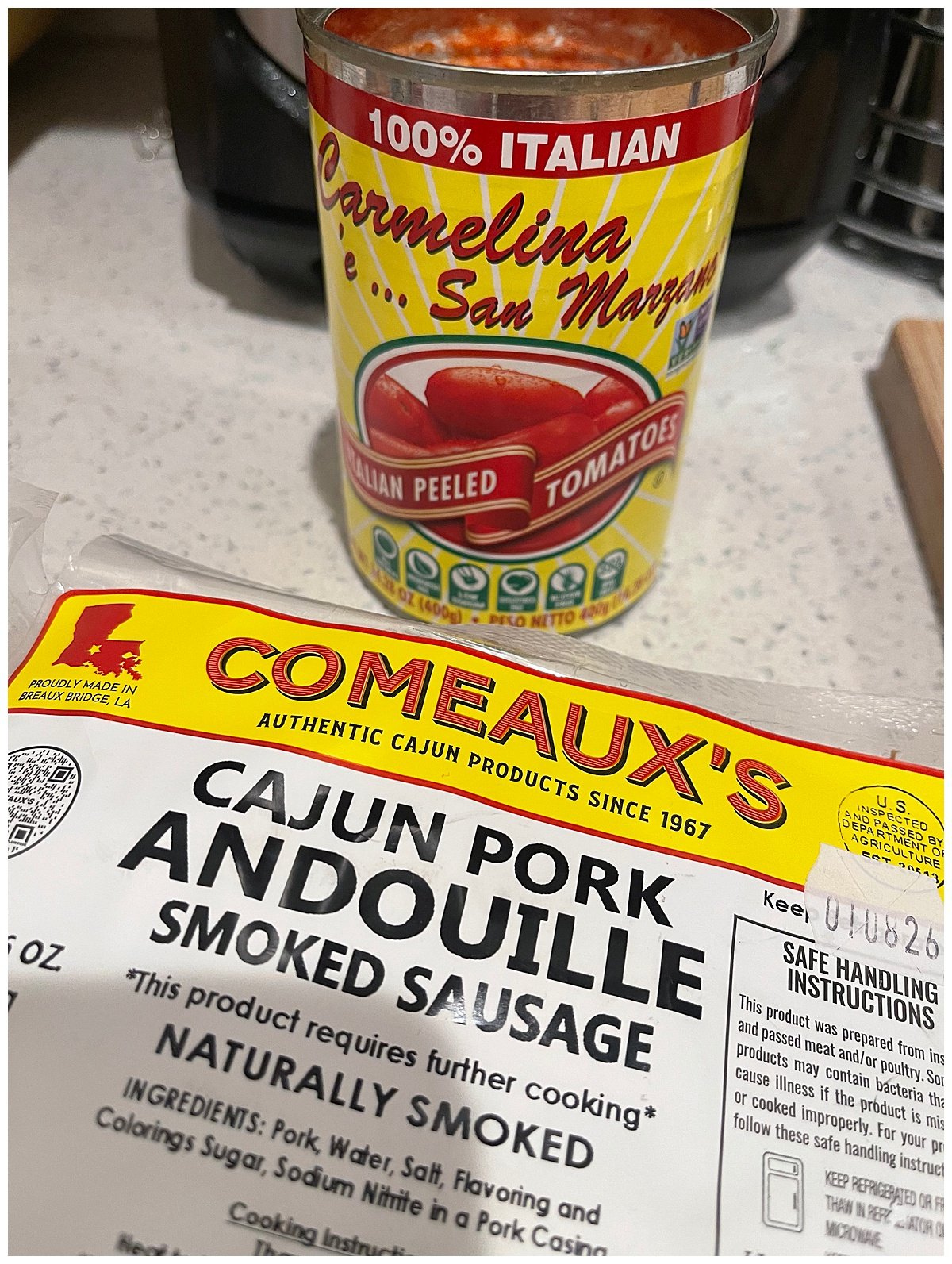
You’ll pay for quality andouille — especially outside Louisiana — but it matters. The sausage carries the dish.
Same goes for canned tomatoes: splurge here.
Recommended:
Comeaux Andouille
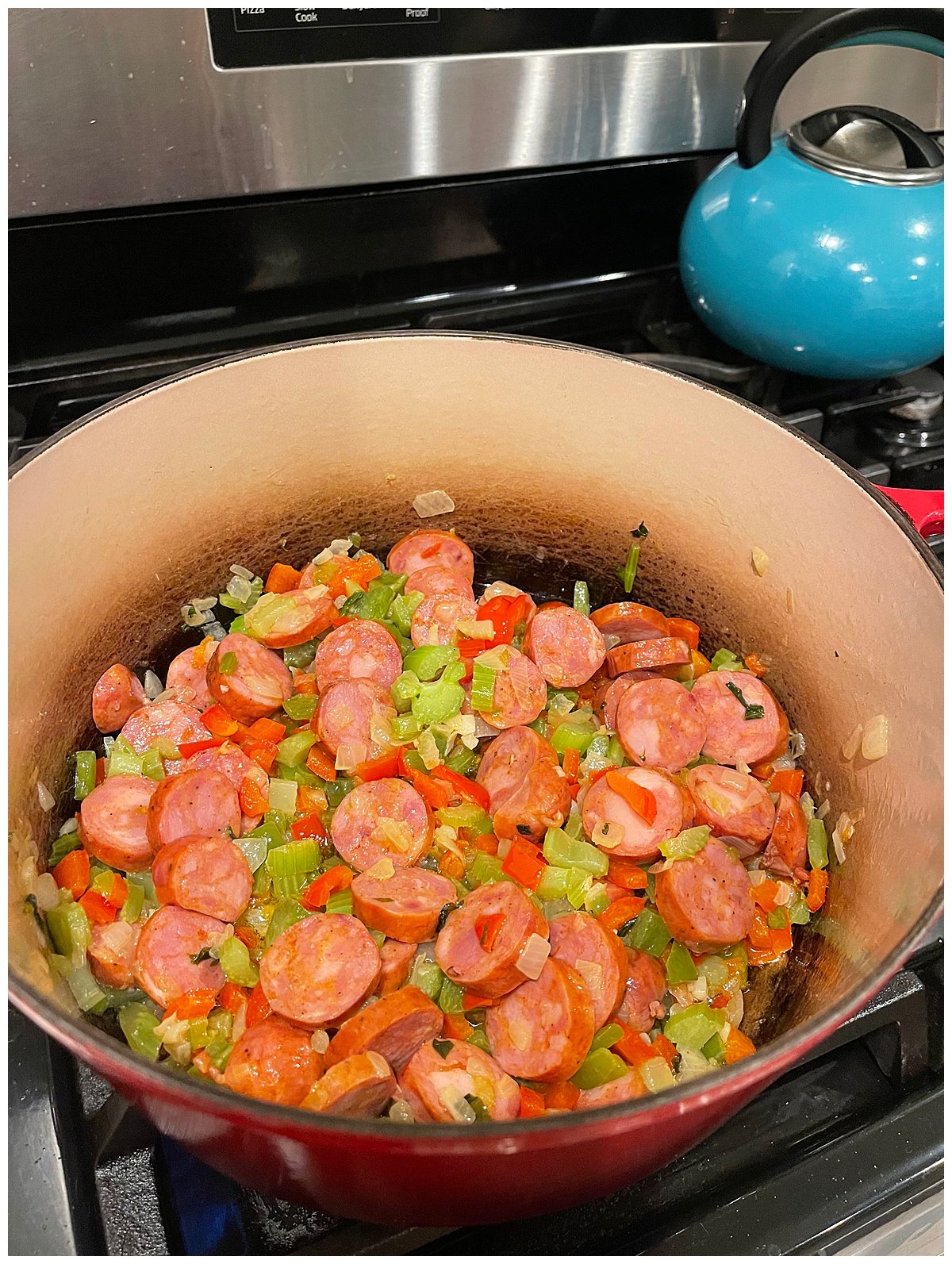
Shrimp take almost no time to cook. Add the sausage first to develop flavor.
If you want extra shrimp flavor, make a quick stock from the shrimp shells and use that instead of chicken broth.
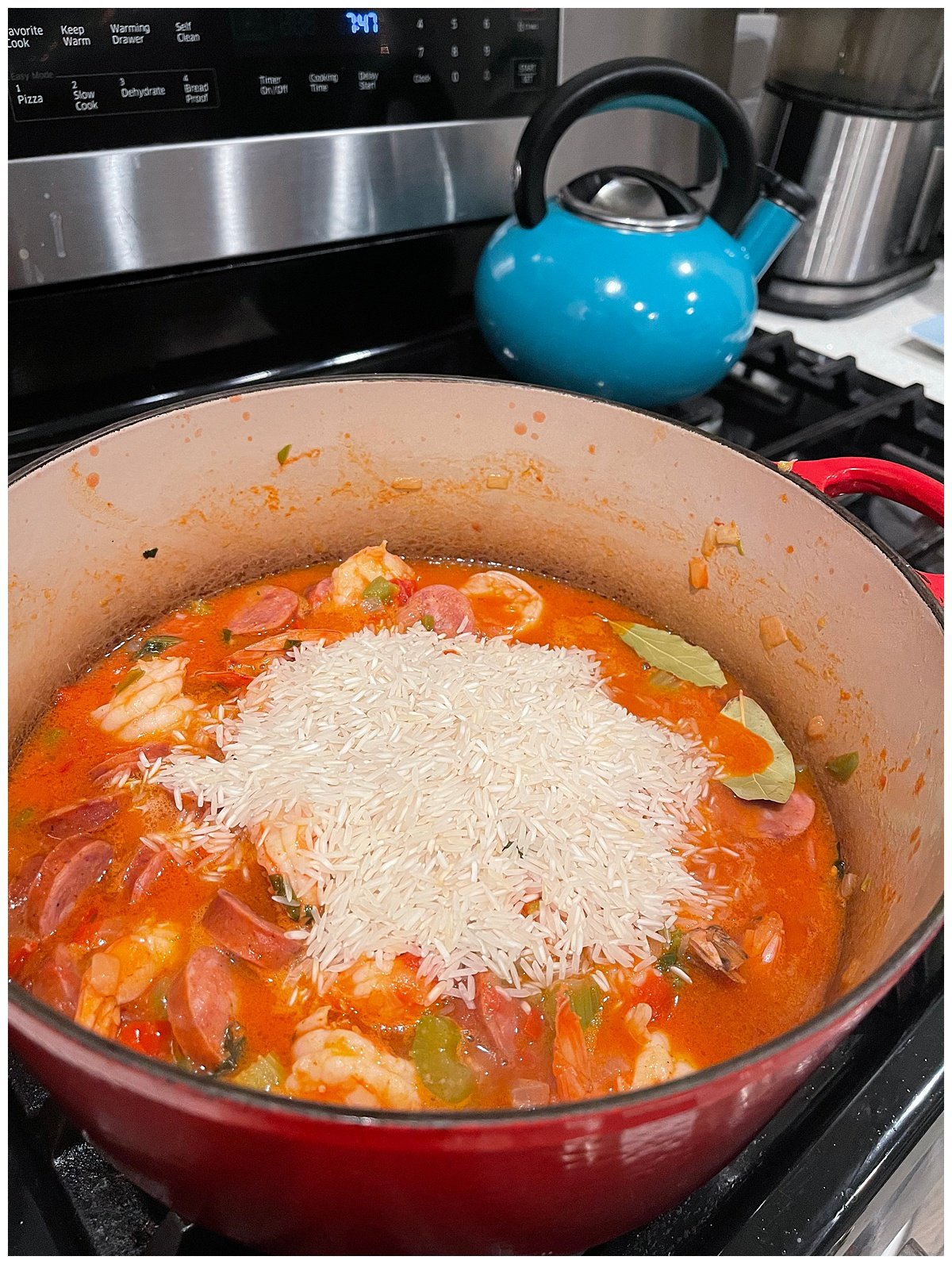
Firm long-grain rice is the right choice for jambalaya. Basmati works beautifully.
One of my favorite Cajun/Creole restaurants uses basmati in their gumbo, and I follow their lead.
Always rinse your rice until the water runs clear.
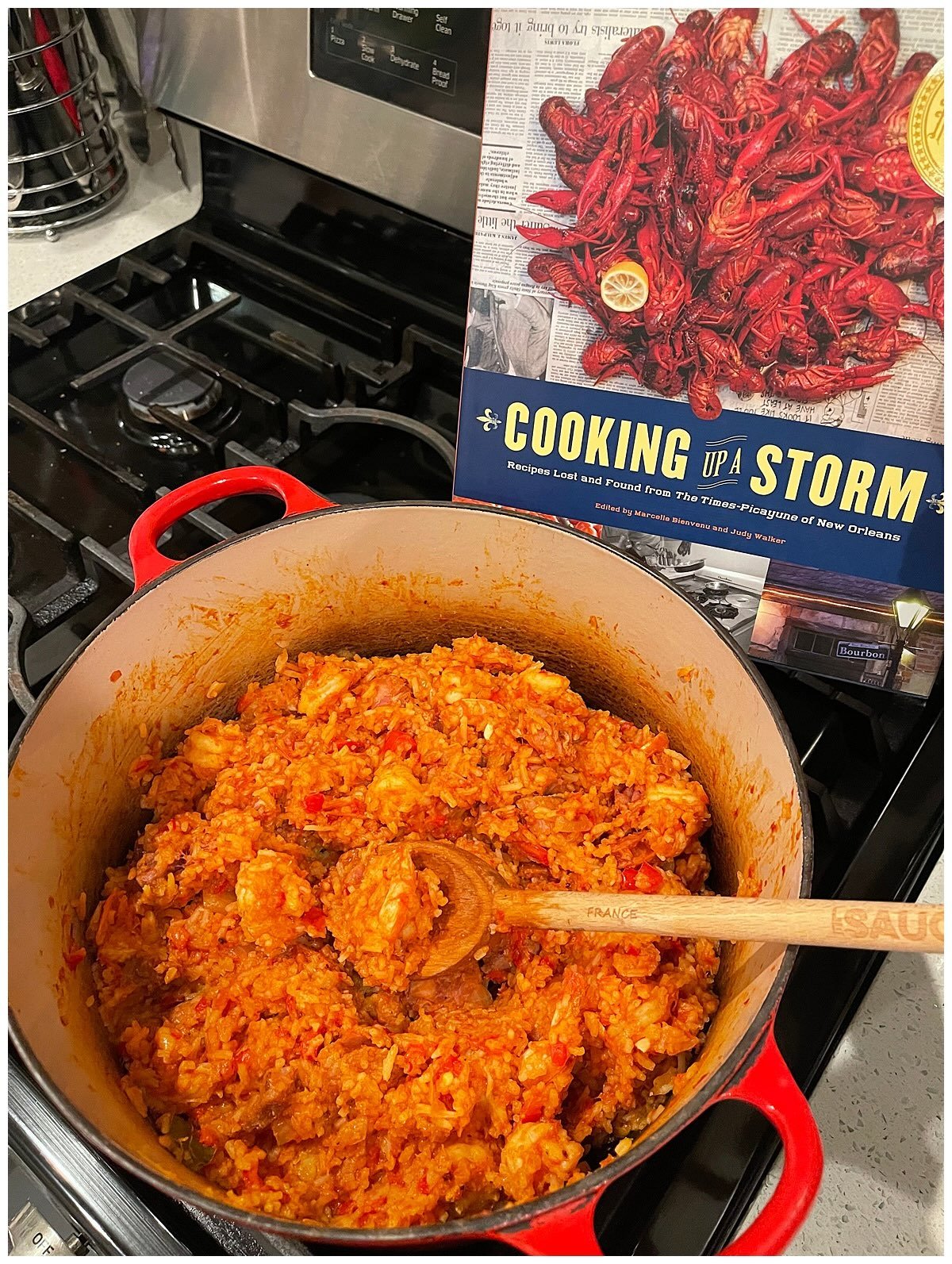
This jambalaya tastes even better after it cools — and it’s fantastic the next day.
It also makes one hell of a side dish with fried chicken.
If you love jambalaya, don’t overthink it. Make it at home. And don’t sleep on using good andouille — it’s the difference between “pretty good” and unforgettable. P.S. here is a link to the cookbook where I got the recipe: Cooking up a Storm
I wax poetic about this jambalaya — and why it means something to me — on my World’s Greatest Dad Substack:
👉 What’s Dad Cooking? Jambalaya My Way
https://worldsgreatestdad.substack.com/p/whats-dad-cooking-jambalaya-my-way
It’s been over ten years since my TV series Cheap Eats sent me across the country in search of affordable food.
Back then, it was a boom time for food trucks, the rise of farm-to-table (at least in marketing), and an American palate that felt increasingly adventurous.
Today, that palate is still hungry for the next big thing — maybe too hungry.
Food trends, fueled by TikTok and other short-form video platforms, have pushed us into a constant stream of birria ramen burritos, BBQ brisket biryani, and other Frankenstein-style mashups. As alarming as that might sound to more seasoned (ahem, older) food folks like myself, a far more serious villain has entered the chat:
The high cost of eating out.
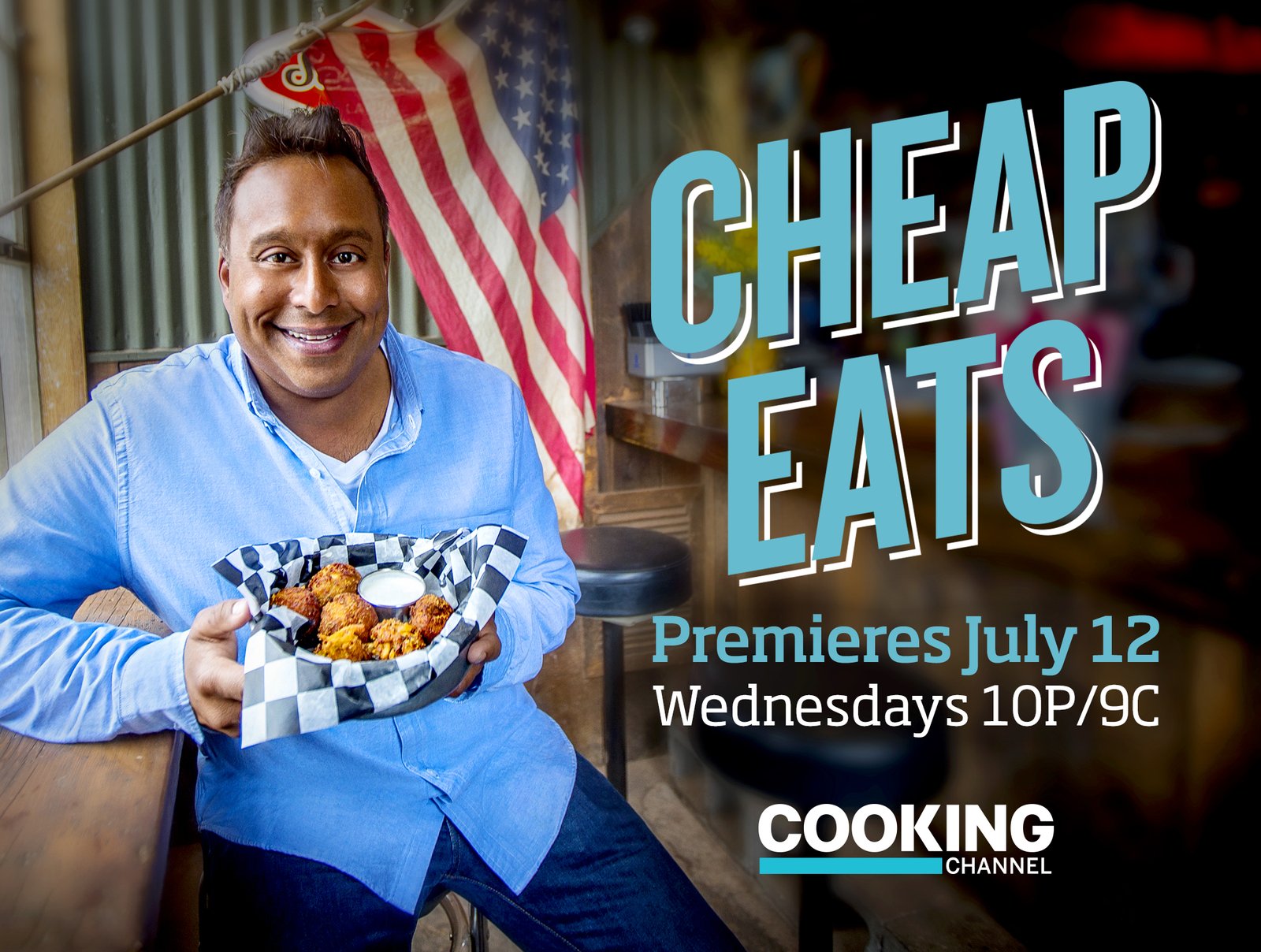
When I filmed Cheap Eats, I had $35 to cover four meals: breakfast, lunch, snack, and dinner. The budget focused only on entrée prices — no tax, no tip, no drinks.
Even then, the number made sense.
Today, that budget feels like a time capsule from the pre-pandemic era. Since then, food costs have exploded. Restaurant wages are up. Rent, in many markets, has climbed right alongside them.
If I had to rebuild that budget for 2026? $80 feels reasonable. $70 would be a challenge.
For most of my adult life, grocery shopping meant sticking to the perimeter: meat, fish, produce, dairy. Frozen food barely registered.
Then I became a parent.
Then I became a parent to a teenage boy.
“Can we get Raising Cane’s?” he asked me at the start of 2025.
That question quickly became a habit — and an expensive one.
Raising Cane’s is a billion-dollar franchise built on a very simple premise: fried chicken tenders and a beloved dipping sauce that lands somewhere between remoulade and a more aggressive Thousand Island. It’s also shockingly expensive.
At our location, combos start north of $10 and can push close to $20 for bigger appetites.
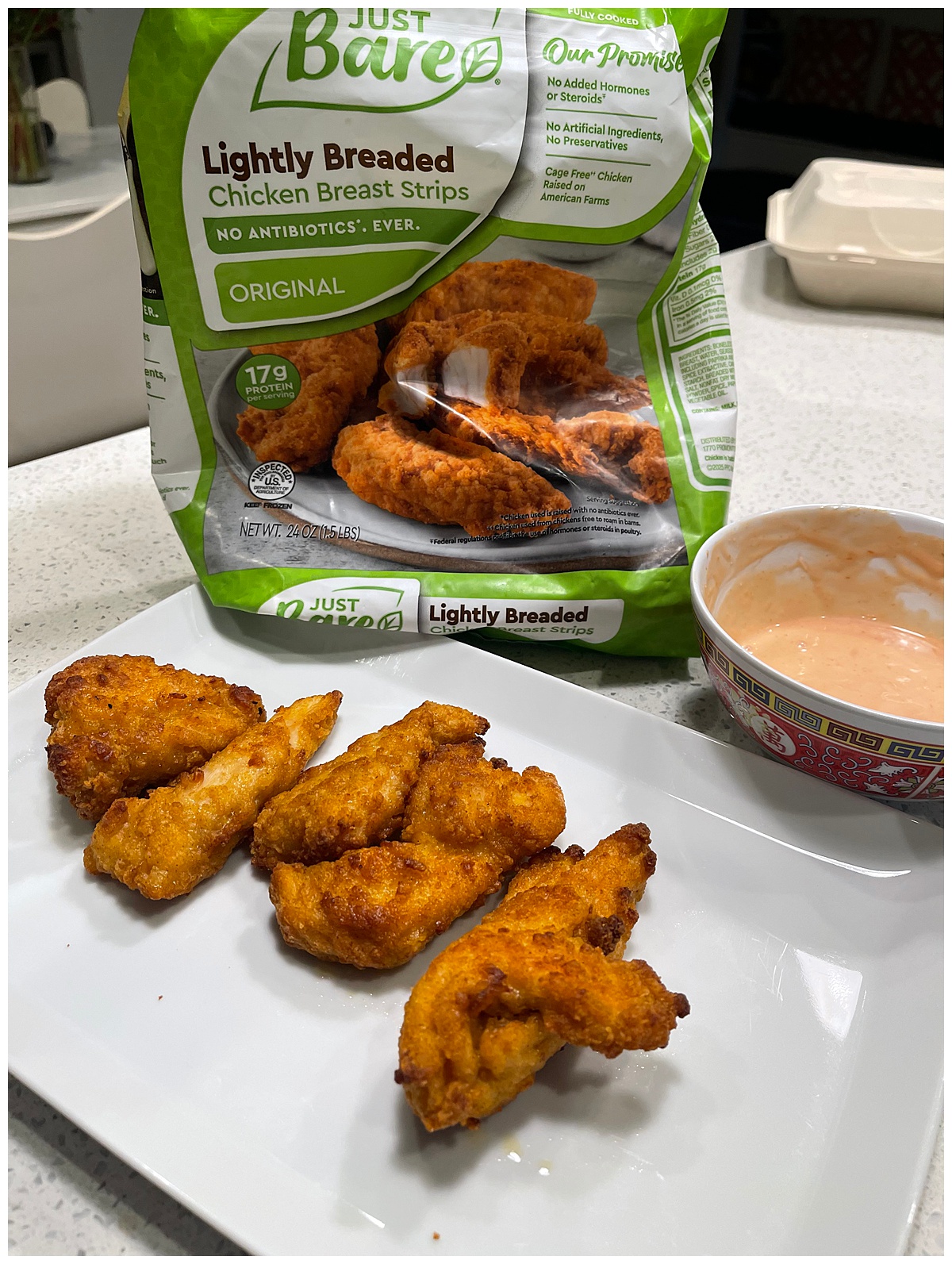
In an effort to curb my son’s Cane’s habit, I turned to the freezer aisle.
Specifically: premium frozen chicken tenders.
They aren’t cheap. At around $12 for a 24-ounce bag, you’re paying roughly 40% more than basic options like Tyson. But it’s still a significant savings compared to Cane’s.
I’ll jump straight to my son’s verdict:
“Not as good.”
Fair.
But here’s my take: premium frozen chicken tenders + an air fryer make a compelling substitute for fast food — both in price and convenience.
I’m not in the habit of eating fast food, or even fast-food knockoffs. But in my increasingly informed opinion, having a decent at-home alternative in a world where “cheap eats” barely exist anymore is a win.
Even if it isn’t as good as Cane’s.
Cheap Eats, as I knew it, may be gone.
But something else has taken its place.
Food tech — Instant Pots, air fryers, flattops, pellet grills — has given home cooks better tools and fewer excuses to overspend on dining out. And the freezer section? It’s quietly leveled up.
Even novice cooks can now compete with fast food that is no longer cheap.
And if you really want to replace Raising Cane’s at home?
I’ve got a recipe for their sauce.
Yeah. It’s that easy.
Series: Is Fast Food Worth It in 2026?
The Vitals: the spot: Chipotle Mexican Grill the eats: Burrito Bowl or really whatever floats your boat the bucks: $$ the question: Is Chipotle still worth it in 2026?
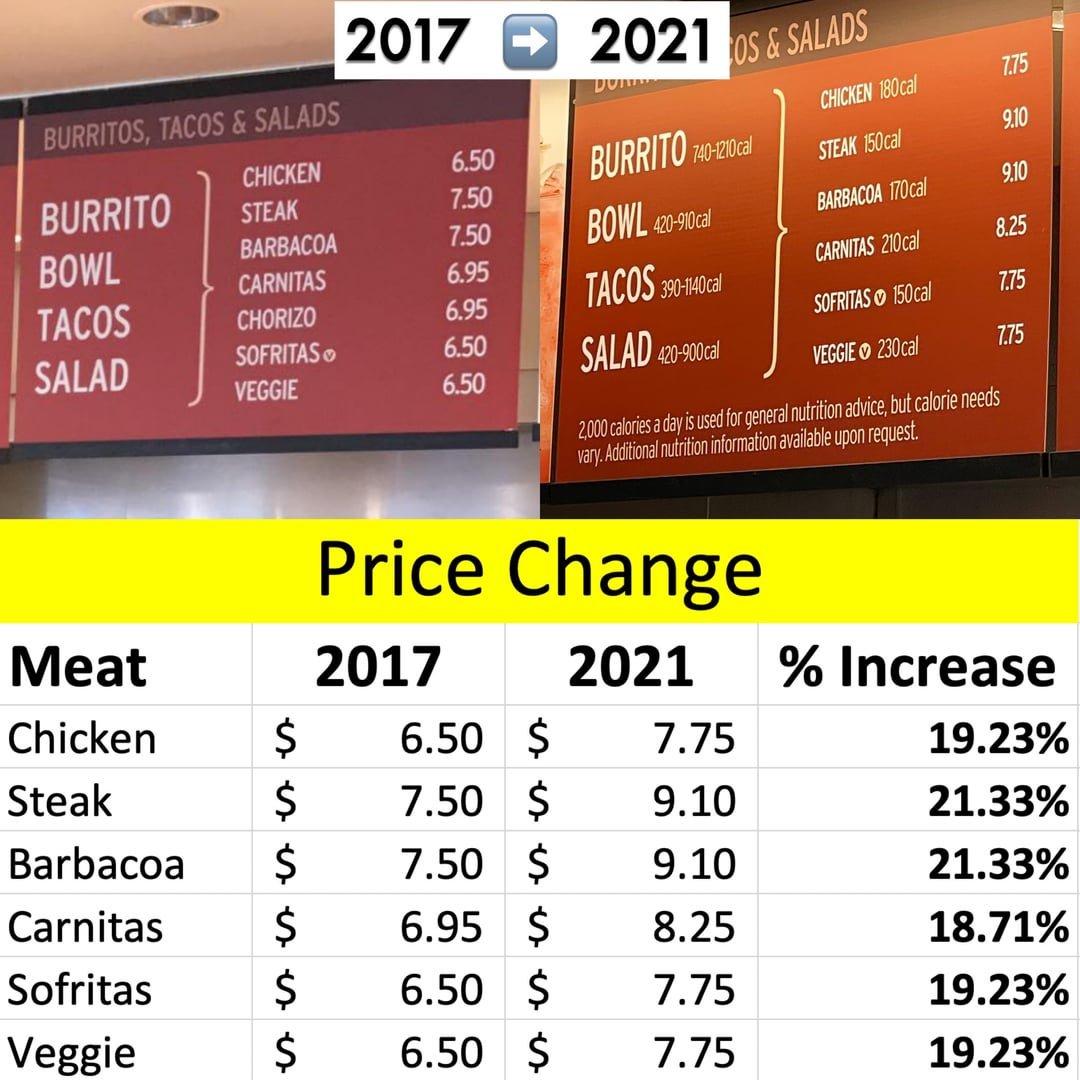
Fast food prices are up. Portions feel smaller. Menus are longer. And value — real value — has become harder to spot.
So instead of ranking chains or chasing hype, I’m asking a simpler question in this series:
Is this meal worth the money, time, and compromise right now?
This post is a companion to today’s YouTube video breaking down whether Chipotle still makes sense as fast food prices climb in 2026.
Chipotle is a good place to start because it sits right in the middle of the modern fast food value crisis — not cheap, not fancy, not nostalgic. Just… reliable fast casual in 2026.
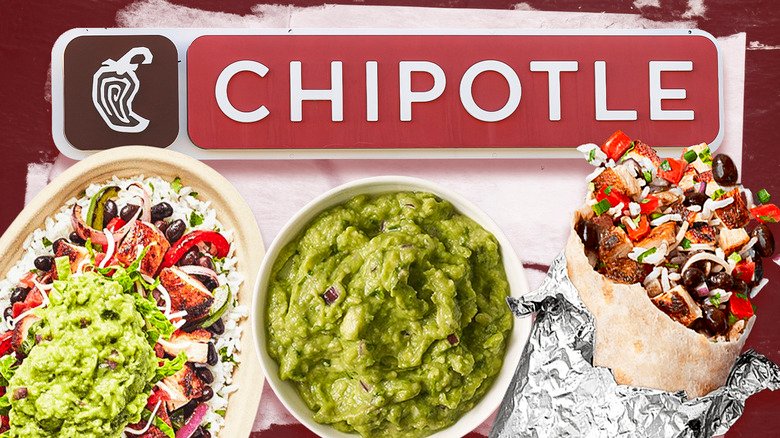
Chipotle is popular and everywhere. Full stop. Never mind the fact that it has its own community on Reddit and that the company is worth billions.
And yet, it’s a far cry from the burrito culture of long-standing taquerias and iconic neighborhoods where Mexican food is prominent — The Mission in San Francisco, Pilsen in Chicago. Chipotle isn’t trying to be that. It’s about convenience.
The food has equal appeal to foodies, fitness folks, and yes… even self-proclaimed “fatties” because — and I’ll admit this — it tastes decent. Good enough. Heck, I’d eat there on a road trip over something like Qdoba (which I’ve also never gone to, lol).
I suppose my foodie (food snob) standards push me over the edge. That, and I love skirt steak and guacamole.
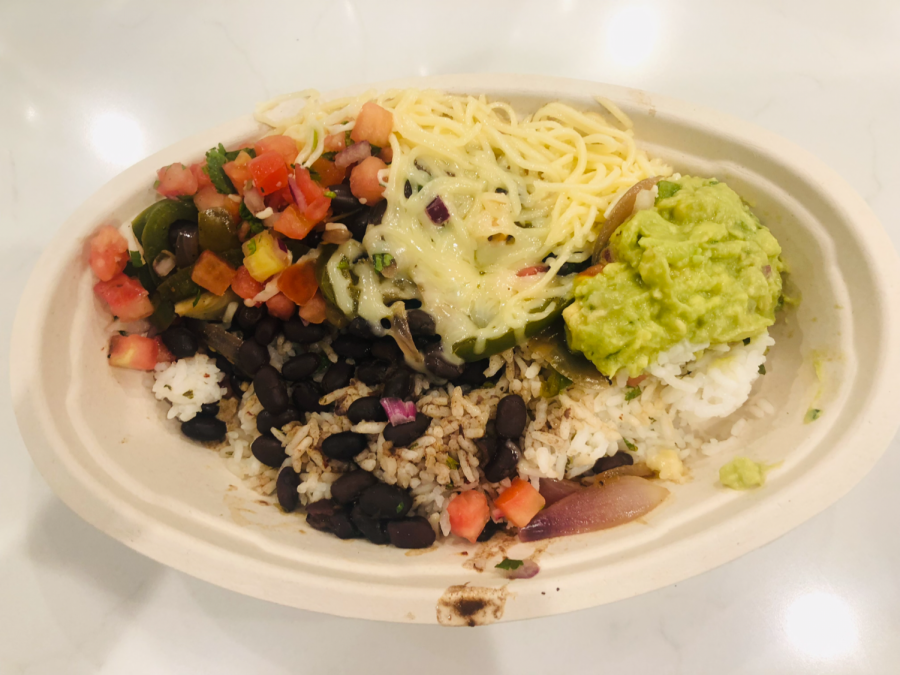
Chipotle almost feels like getting lunch at Whole Foods. You’re presented with a sea of options and the opportunity to build something customizable — healthy, hearty, or both.
It feels like the rare place that can be agreed upon by consensus. Sure, it’s a far cry from a proper burrito at a late-night taco truck. But try convincing Karen from accounting to grab lunch somewhere with no seating and a menu entirely in Spanish.
Oh, Karen…
The burrito bowl remains Chipotle’s strongest value play — customizable, filling, and still perceived as a step above traditional fast food.
Let’s be clear: Chipotle is not cheap anymore.
But Chipotle stays in business because of:
Brand loyalty
A perceived upgrade in health and quality
Customization and variety that feels unmatched unless you go to a sit-down restaurant
Compare that to a typical fast food combo meal:
Fries you didn’t need
A drink you didn’t want
A price that crept up anyway
Chipotle’s value comes from positioning itself as an upgrade over traditional fast food — healthier by perception, more customizable, and only marginally more expensive in 2026.
That distinction matters more than ever.
Here’s the practical test I use:
Will this meal:
Keep me full?
Avoid a second stop later?
Not leave me feeling like I made a dumb financial decision?
Chipotle clears that bar more often than most chains.
It’s also one of the few places where I can adjust the meal depending on the day:
More protein, fewer carbs
Lighter toppings
Bigger portions when I need them
That flexibility turns into value fast when you’re feeding yourself between meetings, errands, and everything else. There are worse options for the dad bod — but it’s still a far cry from what the World’s Greatest Food Dad can do in his own kitchen.
Let’s not romanticize it:
It can be deceptively unhealthy
It’s still expensive
It’s a far cry from a legit taco truck
Chipotle is not where you go for culinary joy. It’s where you go to solve a problem.
Short answer: only in cases of food emergencies.
Long answer: Chipotle is worth it when time, predictability, and customization matter more than price.
Chipotle works when:
You could eat at McDonald’s
Time and limited options are real factors
Karen from accounting won’t touch the taco truck and is debating whether to approve your raise
Chipotle is not great eats. Chipotle is an expensive fast food upgrade. Same rules for fast food apply — but it’s definitely better for the dad bod.
This Chipotle review is part of a larger conversation I break down in today’s YouTube video — looking at fast food value, portion creep, and why some chains still make sense in 2026 while others don’t.
This series looks at major chains through one lens:
Does this meal make sense right now — financially, practically, culturally?
More coming soon.
If this is your first encounter with an authentic Italian bolognese, let me offer a warning and a promise.
This is not a quick sauce. This is ragù alla bolognese, and it requires time — three hours of gentle simmering, closer to four if you start the clock from prep to finish. And it is absolutely worth it.
This recipe comes from one of the most trusted voices in Italian home cooking: Marcella Hazan. Her approach is disciplined, minimalist, and deeply Italian. No garlic. No herbs. No shortcuts. Just technique, patience, and respect for ingredients.
If you want the deeper why behind this cooking adventure, I unpack it over on World’s Greatest Dad, the Substack companion to my podcast. But here, we cook.
True bolognese is not “meat sauce.”
It’s a slow emulsification of meat, dairy, wine, and tomatoes. Milk goes in before the wine. Tomatoes are restrained. The sauce simmers quietly until everything melts into something richer than the sum of its parts.
This is the version served in Bologna — not the red, garlic-heavy sauces most Americans associate with the name.
1 tablespoon vegetable oil (I used bacon fat)
3 tablespoons butter
1/2 cup finely chopped celery
2/3 cup finely chopped carrot
2/3 cup finely chopped onion
3/4 pound ground chuck
Salt and black pepper
1 cup whole milk
1 cup dry white wine (I used red — a weeknight Bordeaux from Trader Joe’s)
A small dash of ground nutmeg
1 1/2 cups canned Italian tomatoes, crushed
(I blended whole canned tomatoes)
Pasta for serving (pappardelle works beautifully; tagliatelle is traditional)
Grated Parmesan cheese, to serve
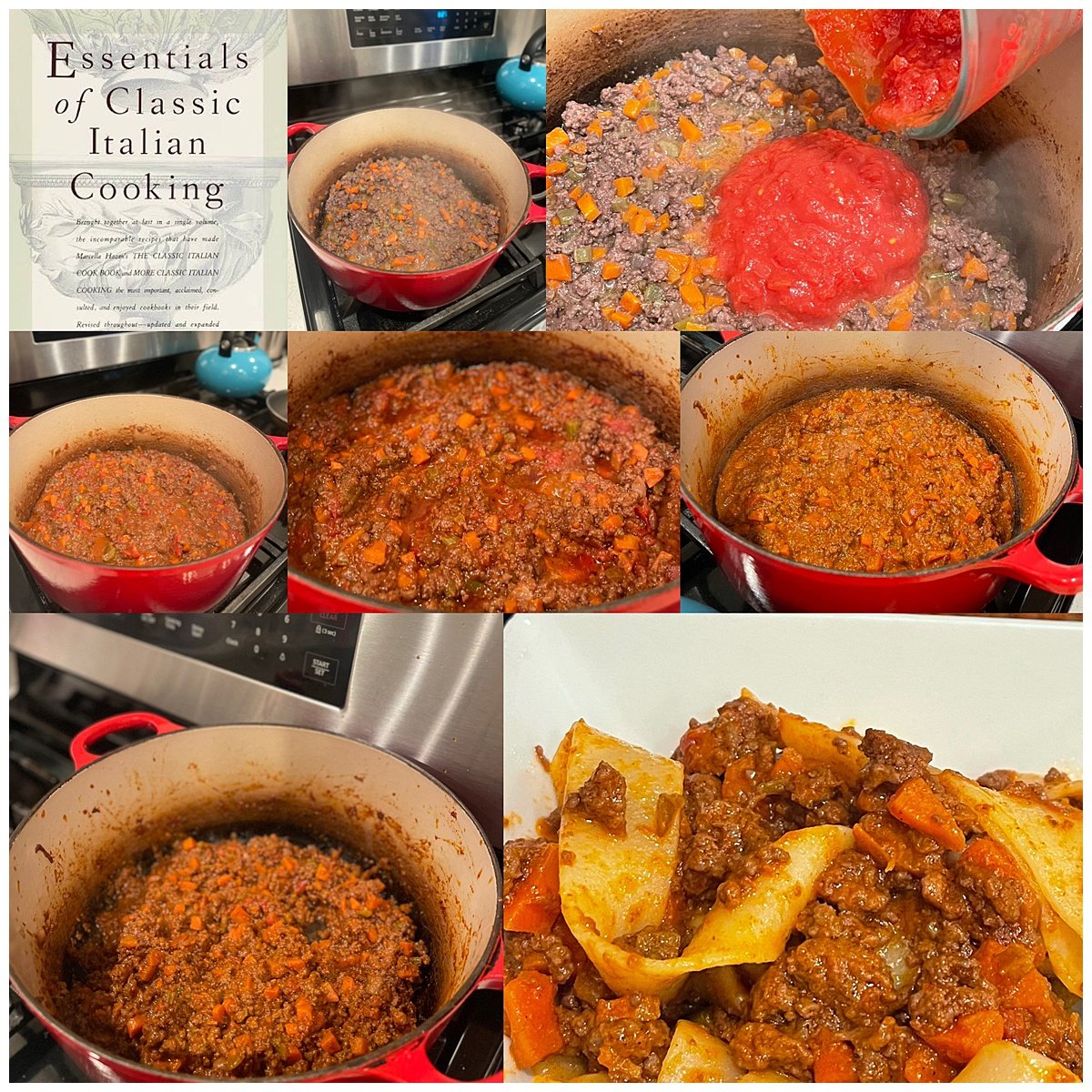
Heat the bacon fat or oil in a heavy-bottomed pot or Dutch oven over medium heat for a full five minutes — just until it’s shimmering but not smoking.
Add the celery, carrot, and onion. Cook gently until the onion is translucent and the vegetables are soft.
Add the ground beef with a pinch of salt and pepper. Cook, breaking it up with a wooden spoon, until the meat loses its red color and turns gray-brown.
Add the milk and let it simmer slowly until it fully evaporates.
Stir in the nutmeg.
Add the wine and let it simmer until completely evaporated.
Add the tomatoes, bring the sauce just to a bubble, then reduce the heat to the lowest possible simmer.
Pro tip: move the pot to a burner that can actually maintain a gentle simmer — usually the small one no one uses.
Let the sauce simmer for three full hours, stirring occasionally.
After two hours it will look finished. It isn’t. Let it go.
Toss with cooked pasta and serve with grated Parmesan at the table.
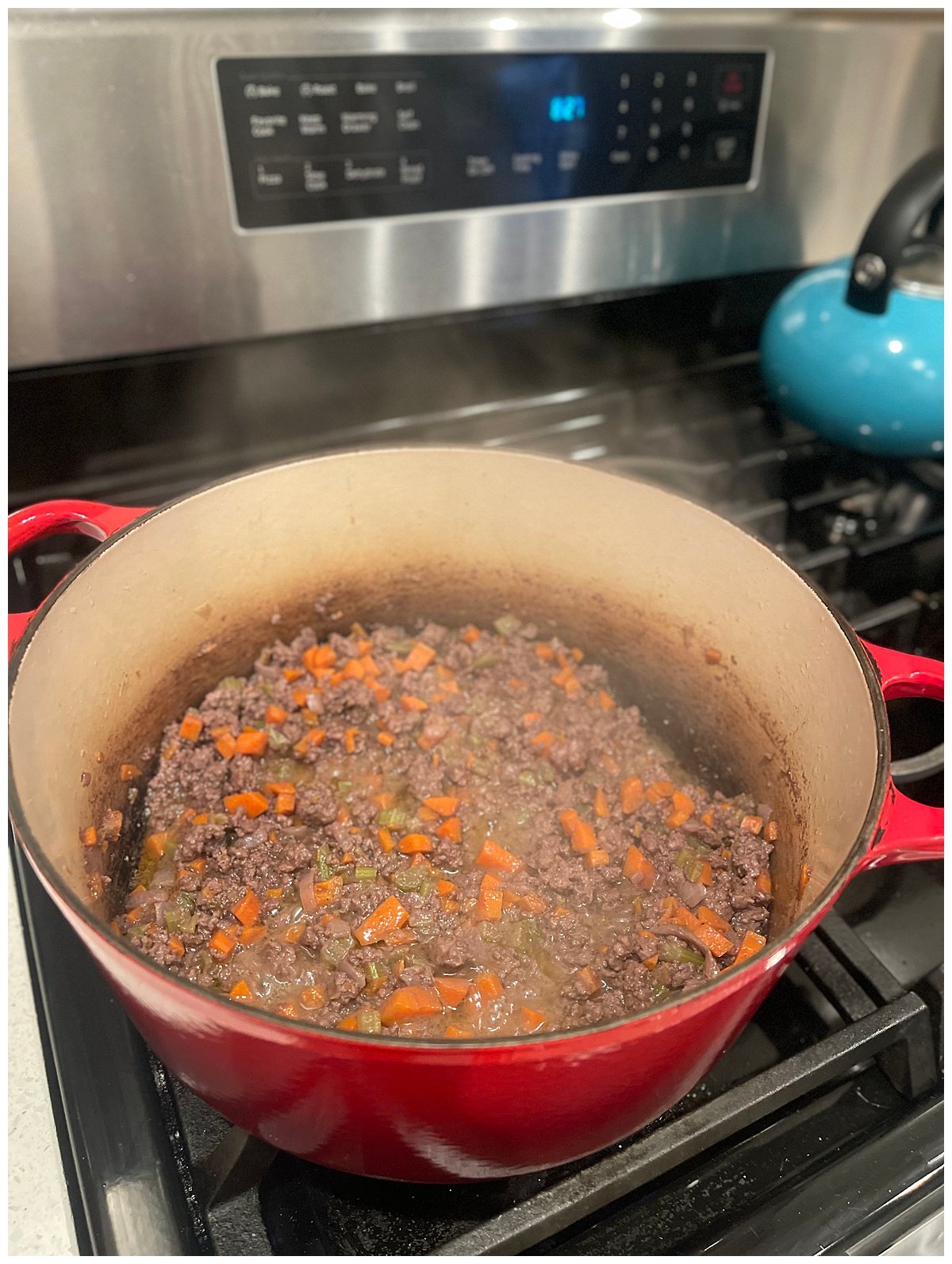 After browning the meat and vegetables.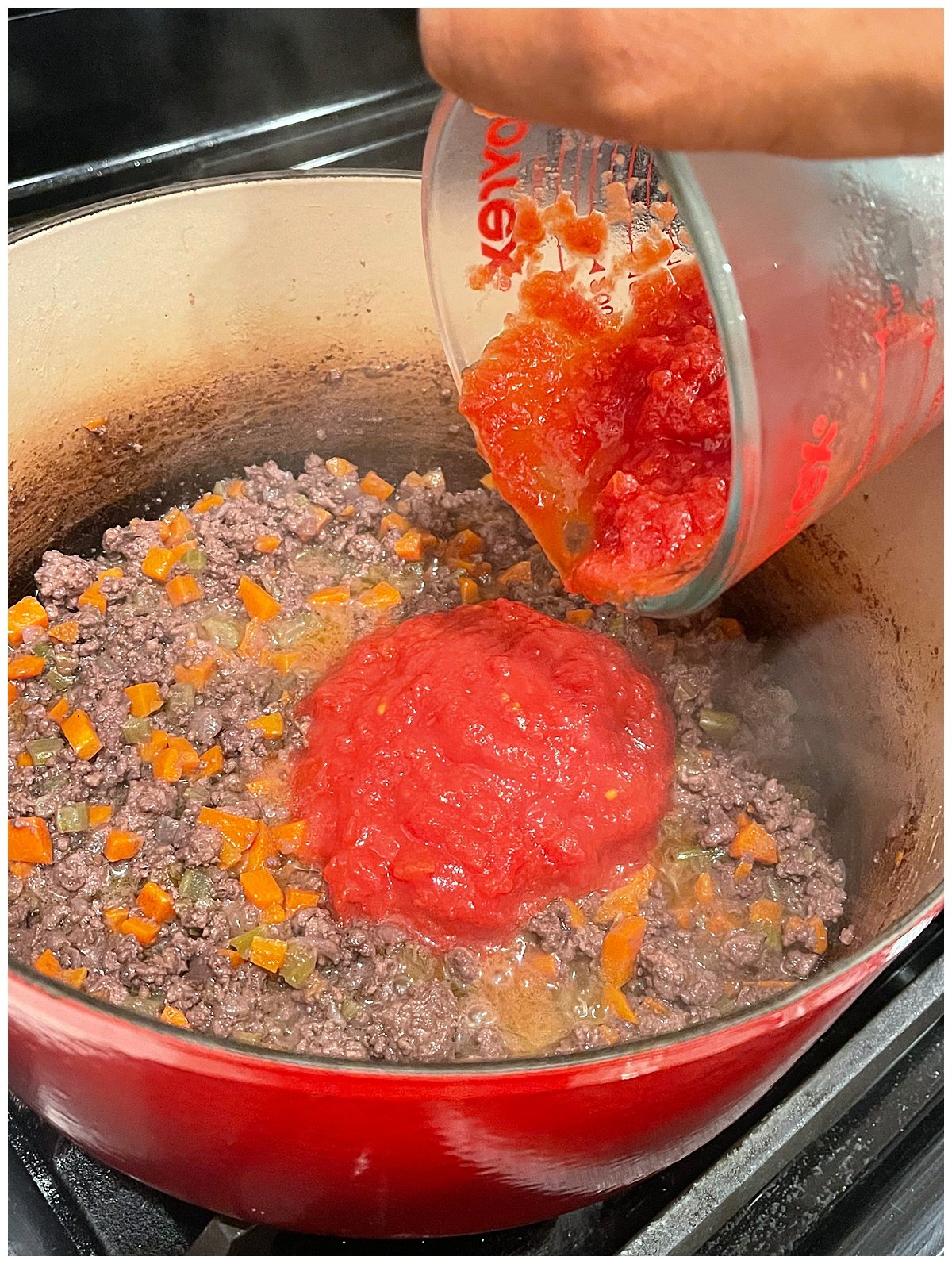
It starts to resemble sauce — don’t be fooled, it still isn't the ragu we are looking for.
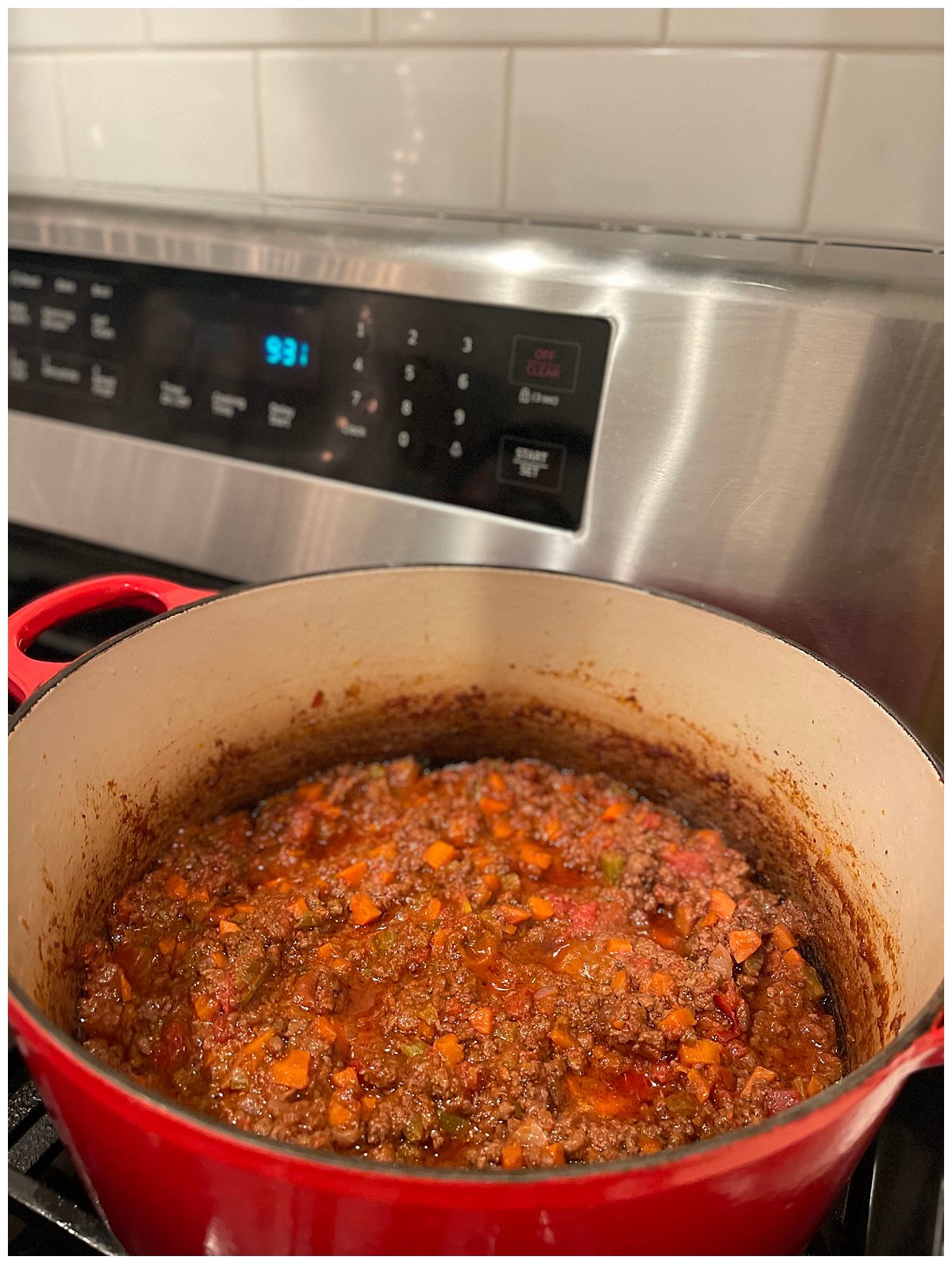
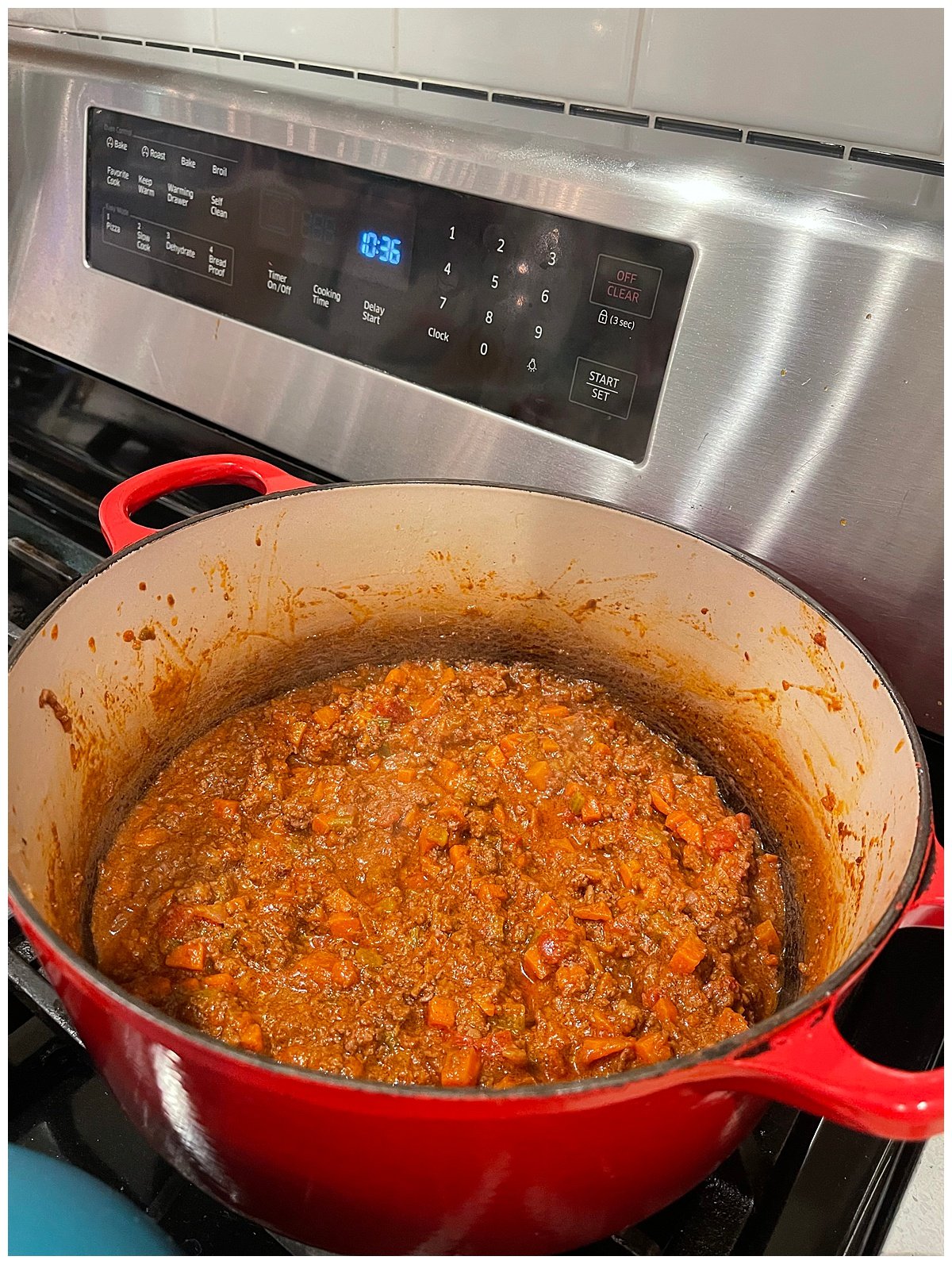
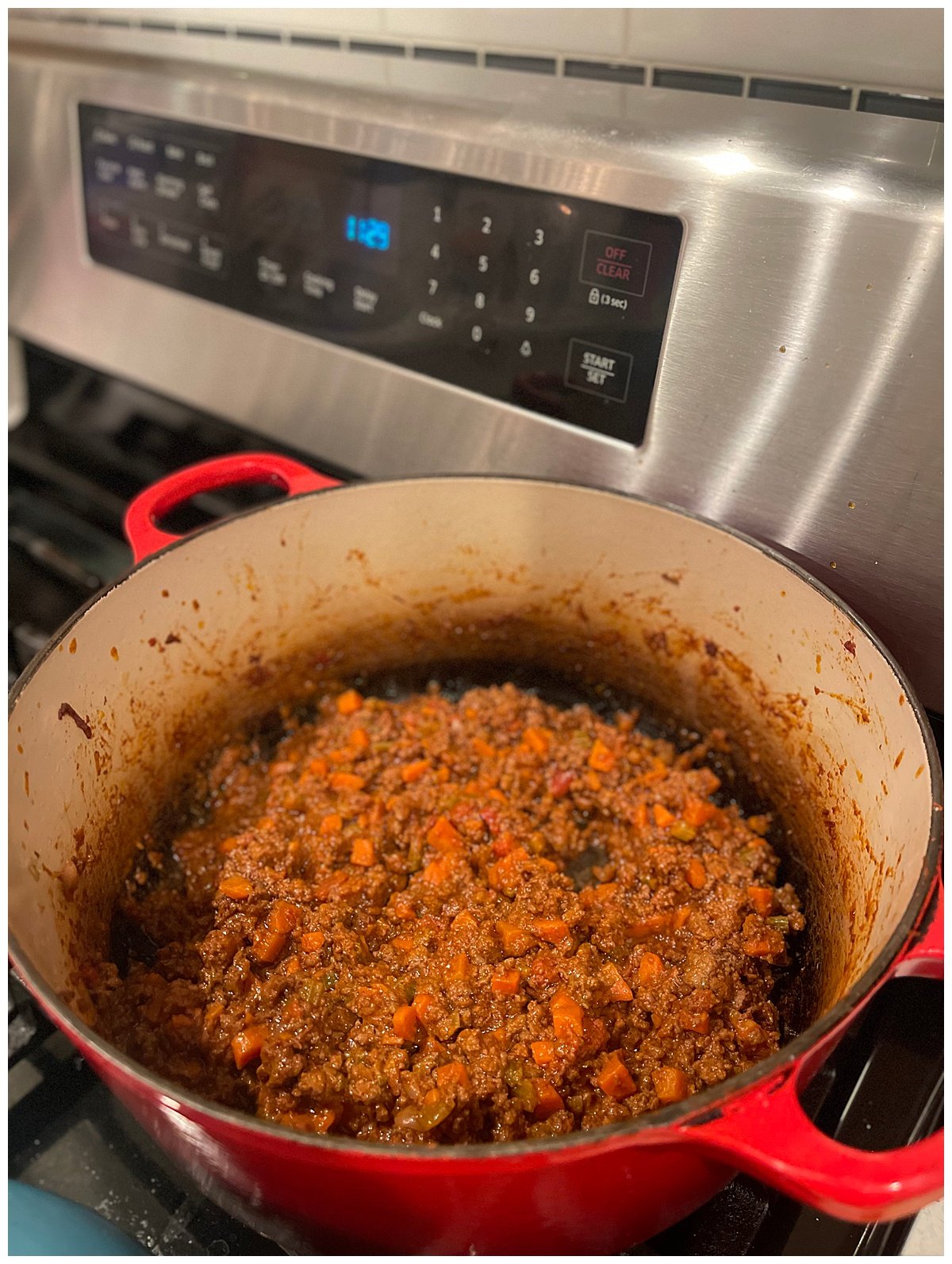
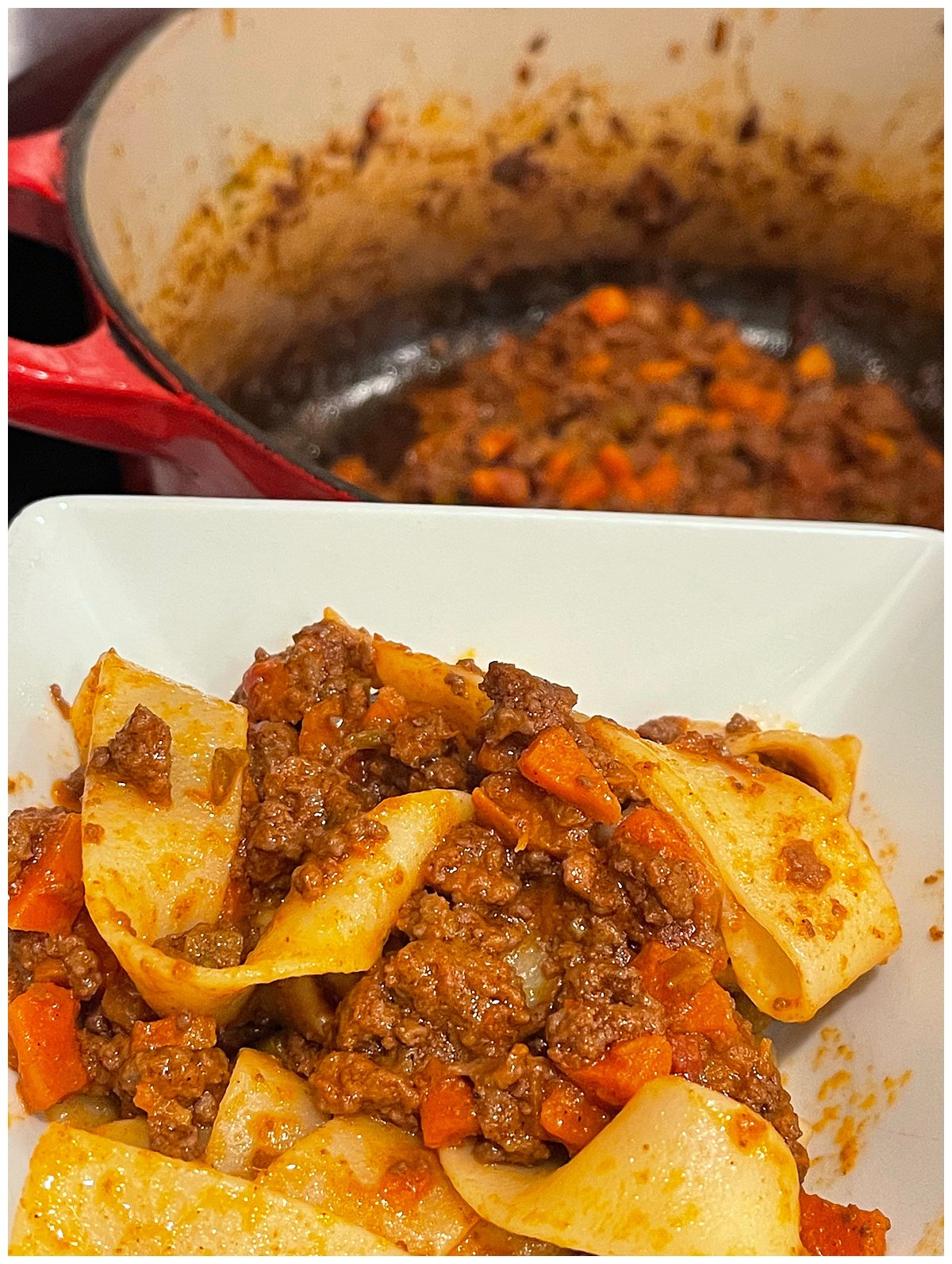
This is not a weeknight sauce — but it is a weeknight meal.
Bolognese improves overnight. Reheat it gently in the oven so the bottom doesn’t scorch, boil fresh pasta, and dinner takes care of itself.
This is the payoff.
My wife’s verdict: “It tastes like restaurant.”
And that’s the truth of it. Great restaurants trade time for flavor — hours most home cooks aren’t willing to invest.
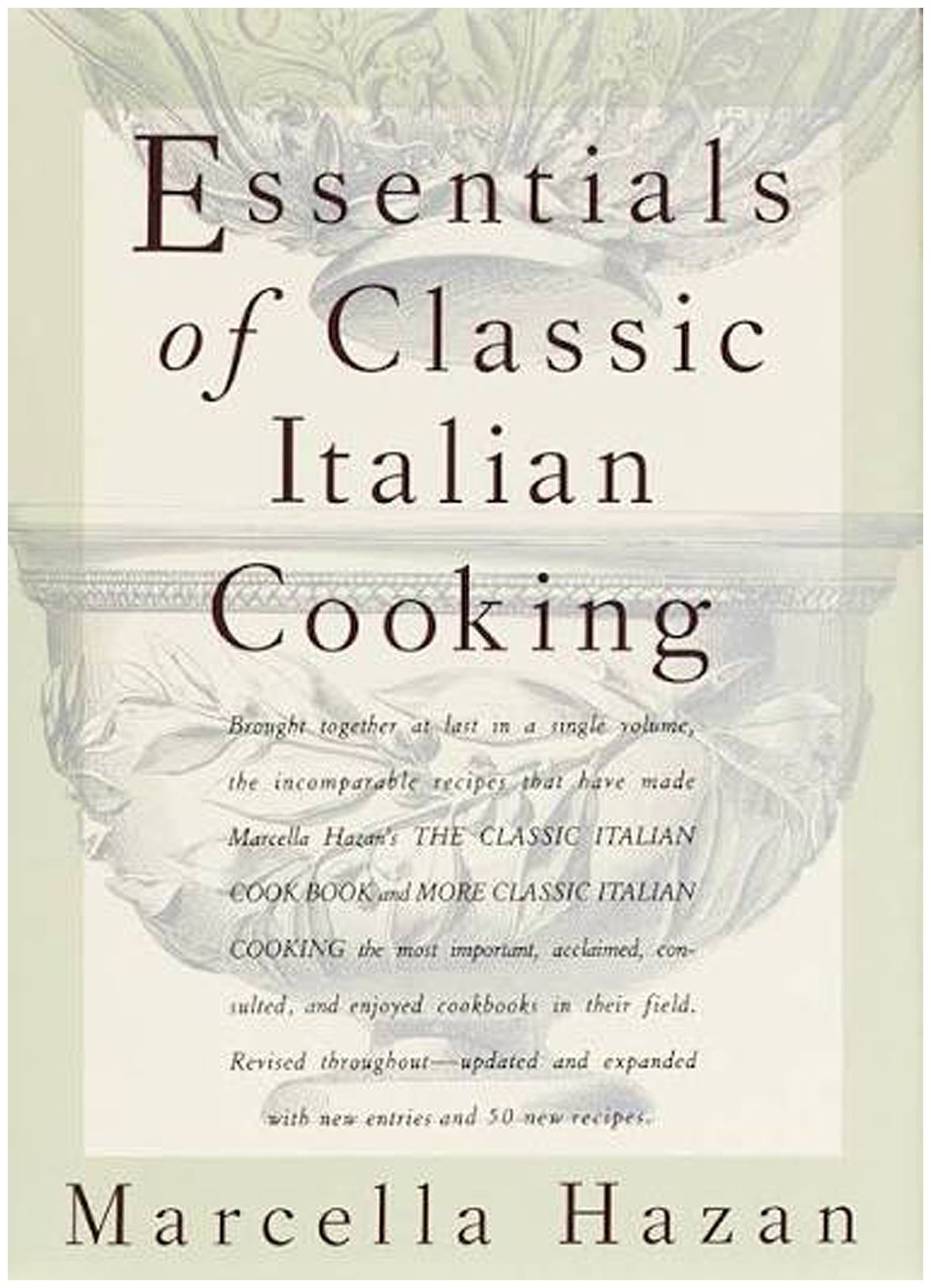
Hazan’s real gift isn’t just the recipes, but the wisdom behind them. Her book remains a food bible decades later. Buy it. Cook from it. Even if this bolognese becomes a one-and-done, you’ll never eat it the same way again.